
Best Outdoor Sprinkler Controllers: 9 Picks in 2026
Value:
Best Outdoor Sprinkler Controllers need to match more than a valve count. The controller may sit on a garage wall, a covered exterior wall, or beside a pump and valve assembly, where heat, damp air, service clearance, and the power route all affect whether a model is a sensible fit. An indoor timer mounted in a weather-resistant cabinet is a different installation from a controller built with its own outdoor enclosure, although both can eventually control the same valves.
This guide compares nine residential controllers by the details that shape an outdoor installation: enclosure and mounting, station capacity, local controls, network requirements, and support for sensors or a pump-start relay. Some are app-first systems; others let you make every change at the panel. A few sit between those approaches, with a conventional timer that can accept a separate connected module. The right choice depends on the system already in the ground and the person who will maintain it.
Before ordering, identify the exact model suffix and check the product listing against the manufacturer’s installation instructions. Product families often share a name while offering different station counts, transformers, or indoor and outdoor versions. The comparisons below call out those distinctions instead of assuming every variation in a family has the same enclosure.
Quick Answer
For a connected outdoor cabinet with visible status at the unit, start with Orbit B-hyve XR 8-Zone. Hunter PRO-HC 12-Zone is a more capable service platform for a larger valve bank, while Hunter X2 14-Zone suits someone who prefers a physical programming panel and may add connectivity later. Rain Bird ARC8 is the compact eight-station option to compare when the Rain Bird app and its outdoor-rated enclosure fit the plan.
- Orbit B-hyve XR 8-Zone for an outdoor-rated smart controller with status displays at the cabinet.
- Hunter PRO-HC 12-Zone for a larger installation using touchscreen setup, Hydrawise, and sensor or flow options.
- Hunter X2 14-Zone for high station capacity and local programming, with Wi-Fi left as an optional add-on.
- Rain Bird ARC8 for eight outdoor-rated stations in a compact connected controller.
Outdoor Controller Comparison
Use the table to narrow the choices, then confirm the exact unit number and enclosure. A product family may have an outdoor and an indoor variant, and one product listing can combine more than one station configuration. The safest comparison is between the exact model you intend to order and the terminals and mounting conditions already on the property.
| Controller | Stations | Control approach | Outdoor detail | Best fit to investigate |
|---|---|---|---|---|
| Orbit B-hyve XR | 8 | App, Bluetooth, panel displays | Designed for indoor or outdoor exposure | Connected control with visible status at the wall |
| Hunter PRO-HC | 12 | Touchscreen and Hydrawise | Outdoor model has a protected cabinet; check model suffix | Large valve map and sensor or flow monitoring |
| Hunter X2 | 14 | Dial and display | Outdoor configuration available | Many stations without requiring a connected setup |
| Orbit B-hyve Smart | 12 | App, Bluetooth, swing-panel display | Locking indoor/outdoor cabinet | App access with a familiar on-unit service point |
| Rain Bird ARC8 | 8 | Rain Bird app and controller buttons | ARC8O is the 120-volt indoor/outdoor version | Eight connected zones in a compact enclosure |
| Rain Bird ESP-TM2 | 8 | Dial and LCD; optional LNK module | Indoor and outdoor configurations exist | Local programming with a separate upgrade path |
| Orbit 57894 Easy-Set Logic | 4 | Dial, buttons, swing panel | Weather-resistant indoor/outdoor cabinet | Compact four-valve replacement |
| Orbit 57896 Easy-Set Logic | 6 | Dial, buttons, swing panel | Weather-resistant indoor/outdoor cabinet | Six valves and local program-based scheduling |
| Hunter X-Core | 4 | Dial and display | Outdoor cabinet available; verify XC-400 configuration | Simple four-station local control |
What an Outdoor Rating Tells You
“Outdoor” is a statement about the approved enclosure and installation, not a promise that a controller can be exposed to every condition without thought. A wall-mounted timer still needs a sound mounting surface, a suitable power source, correctly protected conductors, and enough clearance to open its cover. Manufacturer instructions remain the authority for temperature, humidity, orientation, and wiring limits.
Separate the controller rating from the wall location
A garage interior, a covered patio, an unshaded south-facing wall, and a damp pump enclosure are four different environments. A cabinet listed for outdoor use may be appropriate on an exterior wall, yet it still benefits from a location that avoids direct sprinkler spray, standing water, and unnecessary heat. If the controller will live inside a secondary cabinet, verify that the two enclosures do not trap heat or block access to the door and wiring.
Indoor-only timers can be used outdoors only when the manufacturer approves a suitable protective cabinet for that model. The extra housing has to fit the timer, power supply, wire entries, and service needs. It should not be treated as a generic box that solves every exposure issue. For a replacement, using a purpose-built outdoor version often makes the wiring and maintenance arrangement easier to understand.
Read the power description carefully
Outdoor models may use an internal transformer or a corded power arrangement, while indoor versions often use a plug-in transformer. That difference changes where an outlet must be available and how the unit can be mounted. It also matters if the existing controller is hardwired. Match the electrical configuration rather than choosing a unit by station count alone, and use a qualified installer where the work involves household line voltage.
The station terminals operate low-voltage valve circuits, but a pump-start terminal is not the same as permission to connect a pump directly. Many controllers use that output to trigger a compatible relay. Confirm the relay requirements and the controller’s current limits. If the property has a master valve, pump, rain sensor, or flow meter, make a terminal-by-terminal plan before removing the old timer.
Weather resistance does not extend Wi-Fi range
Connected controllers have a separate siting question: can the unit maintain a usable network connection at the final mounting point? A strong signal inside the living room does not prove that it reaches through an exterior wall, metal enclosure, or detached garage. Pair the controller where it will remain, and check the signal before closing the cabinet and dressing the wires.
Some models also support Bluetooth, which can make initial setup or nearby service more convenient. That does not replace a stable internet connection for remote features that depend on the cloud. A physical display or buttons are useful when an app cannot reach the unit, but each model handles local operation differently. Check what can be started or adjusted at the controller itself.
Expect the enclosure to be part of routine service
Leave room for the door to swing open, for the cover to be removed, and for a hand to reach the common and station terminals. Label the valve wires before they enter the cabinet. If the display is mounted outdoors, consider whether it can be read without standing in the sun or reaching over landscaping. A small amount of planning can save time during a midseason valve check.
Outdoor placement also exposes labels and plastic surfaces to sunlight and seasonal temperature swings. A protected, shaded position can make inspection more comfortable and reduce avoidable exposure. Avoid concealing a controller behind storage, vines, or equipment that makes the shutoff and manual controls hard to reach.
Choose by the Valve Map and the Person Who Will Use It
The number of sprinkler heads is not the number of controller stations. A station usually operates one valve circuit, and a valve may feed several heads. Walk the property or use the existing controller labels to count active valve wires. Then note which areas each one serves and whether any valves share a schedule today.
Buy capacity for a real circuit
Four stations can suit a compact front-and-back lawn with two separate planting areas. Six or eight outputs are useful when a side yard, foundation beds, vegetable garden, or drip line needs its own timing. Twelve and fourteen stations fit larger properties, but they add little value when most of the terminals will stay unused and there is no expansion plan.
A station reserve is sensible when a new valve is already part of a landscape project. It is less useful as a vague hedge against future changes. A controller cannot divide one existing valve into two schedules; that requires plumbing and a separate valve circuit. Capacity should follow the irrigation layout, not the number of zones that would look convenient on a screen.
Know whether schedules are program-based or zone-based
Program-based timers group stations under a shared schedule. That can simplify a system where several zones have similar watering days, though it takes care to avoid giving very different planting areas identical runtimes. A zone-based interface puts the schedule for one area in view. Neither arrangement is inherently better; the useful question is whether the person making seasonal changes can tell which setting affects which valve.
Give every station a plain-language label, such as “front turf,” “north bed,” or “drip line.” A controller’s numbering is only useful while the person servicing it has the matching valve map. Keep a printed copy inside the enclosure or in the property’s maintenance notes, and update it if a valve or landscape area changes.
Choose how much connectivity you actually need
An app can help a homeowner pause a schedule while away, check watering history, or give a landscaper temporary access. Forecast-based adjustments are useful only when the location, plant settings, and network connection are set up thoughtfully. A connected feature should answer a maintenance task that matters on this property, not merely add another account to manage.
A local dial and display may be preferable when the schedule changes infrequently or the person servicing the system does not want to rely on a phone. Hybrid options such as X2 and ESP-TM2 can be used locally, with a separate module available for later connectivity. That can defer the decision, but the module and setup are additional parts of the overall cost.
Check every extra input before buying
Rain sensors, freeze sensors, soil sensors, pump-start relays, and flow meters are not interchangeable accessories. Verify the number and type of supported inputs, the wiring method, and any separately required hardware. A controller may show a sensor terminal yet still need a specific sensor model or configuration to use the feature you have in mind.
Flow monitoring deserves special attention. Some controllers accept an optional flow meter and report unusual use; the meter itself, fittings, placement, and any subscription requirements may be separate. If the goal is leak detection, confirm the full path from the meter through the controller and software instead of assuming that a “smart” label includes every component.
How We Evaluated the Outdoor Options
The comparisons emphasize the parts of a controller that become difficult to change after installation: enclosure, transformer arrangement, station count, terminal layout, and access to the controls. We also looked at the difference between a model with built-in Wi-Fi and one that can accept an optional module. These distinctions affect both the upfront purchase and the tasks the owner can perform later.
Product specifications do not establish that a particular schedule will be right for a yard. Soil, slope, shade, sprinkler type, pressure, local restrictions, and plant maturity all matter. We therefore treat weather adjustment as a tool for managing a schedule, not as a substitute for checking the soil and the actual coverage. No product here is presented as personally tested.
Orbit B-hyve XR 8-Zone
The XR stands apart visually. Three active-matrix displays and a status light ring put information at the cabinet, which is a useful design choice when the controller is on an exterior wall and the owner wants a quick read before opening the app. It can show activity by zone, while the swing-through installation and push-fit wiring help keep the terminal area accessible during a replacement.
For the eight-station version, the strongest use case is a property with a settled valve map that still benefits from connected schedule changes. Orbit lists an indoor/outdoor enclosure, dual-band Wi-Fi, Bluetooth, local status displays, weather-based programs, and a pump-start relay connection. Those features can make seasonal adjustments easier to manage, but first-time setup still depends on the network reaching the cabinet and on accurate details for each watering zone.
The program structure leaves room for several custom schedules and multiple start times, including cycle-and-soak use. That is valuable when the same station needs a pause between shorter runs, such as on ground where a long cycle tends to produce runoff. The app can also keep watering history, which gives an owner a reference point when checking whether a schedule change altered runtime.
Do not assume the “8-zone” text describes every version in the XR family. Orbit sells more than one station count under the same product family, so confirm the exact variant in the cart and inspect the wire terminals on the installed model. Outdoor readiness also does not solve a weak Wi-Fi signal; the controller’s location should be tested before the old unit is removed.
For an owner who wants to see activity at the wall and make adjustments remotely, the XR’s combination of displays, local controls, and app access is unusually practical. A buyer who wants the least connected setup may find that it has more interface than necessary, while a growing valve map could make the eight-station version feel tight.

Pros
- The display cluster lets someone checking the exterior cabinet see watering status without first opening a phone app.
- Dual-band Wi-Fi gives owners more flexibility when the home router does not use a 2.4 GHz-only network.
- Cycle-and-soak scheduling can break a long run into shorter intervals for areas that absorb water slowly.
Cons
- Remote weather features still depend on successful network setup at the controller’s final mounting location.
- The eight-station version leaves little spare capacity if the property is likely to add several valve circuits.
The displays are the XR’s distinguishing detail in this group. For an eight-valve map, the mix of an at-the-wall status check and app access is useful when the Wi-Fi reaches the cabinet; poor signal would make the connected side less dependable.
To buy this product, click here.
Hunter PRO-HC 12-Zone
Hunter’s Pro-HC makes more sense on a larger valve bank than on a small yard. Twelve stations provide room to keep lawn, trees, beds, and separate drip circuits apart, while Hydrawise adds a service layer for owners who want to monitor more than start times. The full-color touchscreen is important here because it gives the person standing at the outdoor cabinet a way to configure and test the system without beginning every task on a phone.
There is a distinction between the Pro-HC’s core controller and the monitoring hardware that can be added around it. The controller has two sensor inputs and a pump/master-valve output; compatible sensors and a flow meter can expand what the system reports. The flow meter is a separate installation decision, not something to assume comes in a standard controller package. If flow alerts are the reason for buying, price and plan that entire setup. The 12-station Pro-HC family includes indoor and outdoor configurations. The suffix and transformer arrangement determine which one is in the box, so inspect the specific listing carefully. Hunter specifies 2.4 GHz Wi-Fi for this model family. A home that has only a 5 GHz network, a distant access point, or a metal enclosure between the router and the controller needs a connection plan before the outdoor unit is mounted.
Its deeper feature set has a payoff when someone will use it. A groundskeeper overseeing a large landscape may value wiring alerts and the ability to review system activity; a homeowner with a simple weekly routine could find a dial controller quicker to maintain. Consider the number of inputs, the expected water-management routine, and the person who will own the app account together.

Pros
- The twelve-station layout keeps a large set of valves independent when different areas need distinct schedules.
- The touchscreen makes commissioning and manual checks possible at the cabinet even for an app-connected installation.
- Two sensor inputs and an optional flow meter give a service-oriented owner room to build a more informative system.
Cons
- Hydrawise features are most useful after someone completes the account, network, and zone-setup work.
- The correct outdoor transformer version must be confirmed because the family also includes indoor configurations.
A twelve-zone property with someone responsible for maintenance can put the Pro-HC touchscreen and sensor paths to work. The flow-monitoring case only holds after a compatible meter is added; without anyone reviewing alerts, this is a substantial controller for a routine weekly schedule.
To buy this product, click here.
Hunter X2 14-Zone
Fourteen stations is the reason to look at this X2. Many conventional residential timers stop at eight or fewer outputs, so a large property can end up comparing a professional control platform against a simpler dial-based alternative. X2 retains the familiar Hunter faceplate and local programming, which keeps the day-to-day task straightforward for an owner who does not need a phone to run a zone.
The controller family supports indoor or outdoor installation and comes in fixed station counts, including fourteen. The exact unit and power arrangement still matter, especially when replacing a hardwired cabinet. Take a terminal photo, count the existing valve wires, and check the labels before selecting a model with the same station number. Hunter’s WAND module is an optional route to Hydrawise connectivity. It should be treated as an additional purchase and setup step, not a feature automatically included with every X2 package. If the property will remain local, there is no need to plan around the app. If remote control is likely, compare the combined cost and installation with a controller that includes Wi-Fi from the start.
The X2’s appeal is the balance between a high fixed station count and a simple control surface. Its limits are just as clear: app access requires the accessory, and a fixed-capacity controller will not grow through expansion modules. A planned outdoor model can suit a substantial residential system; someone with a small valve map could pay for terminals that never see use.

Pros
- Fourteen fixed stations let a large residential valve map stay on one controller without grouping unlike areas together.
- Local dial programming gives a groundskeeper a direct way to test and adjust watering at the outdoor cabinet.
- The separate WAND option leaves the choice of connected control open without making it part of the base setup.
Cons
- Remote app access requires the WAND module, so buyers should compare the full connected-system cost before choosing.
- The fixed fourteen-station capacity is more controller than a compact landscape is likely to use.
Fourteen valves make the X2 compelling if local control is welcome and Wi-Fi can remain optional. If the app is a day-one requirement, include WAND in the price and installation plan; the controller will not add stations through expansion modules later.
To buy this product, click here.
Orbit B-hyve Smart 12-Zone
A lockable cabinet and swing-panel display give the 12-station B-hyve a different feel from controllers that treat the app as the only useful interface. The panel keeps settings and manual runs available at the installation, while the phone connection can help when the owner is away or wants to review a schedule. That mix is especially useful on a property where someone else may occasionally need to operate a zone.
Orbit lists indoor/outdoor installation, Bluetooth and 2.4 GHz Wi-Fi, four program slots, manual operation, and weather-based adjustments for this product family. The 12-station configuration gives a larger residential system space to separate watering needs. A schedule for a sunny lawn can stay distinct from a shaded bed or drip branch, as long as each area has its own valve.
The cabinet also has a practical role in an exposed service location. It keeps the panel and wiring together and can be locked, though it still needs correct mounting, a usable power route, and clear room for the door. A strong outdoor rating does not remove the need to keep the unit away from direct irrigation spray and standing water.
Connected programs can make rain delays and schedule checks convenient, but remote operation rests on the local wireless connection and the account used to set up the timer. If the owner prefers a permanent physical routine, the display helps. If the property is managed by several people, decide who will hold the account and how access will be shared before the first schedule is saved.

Pros
- The swing-panel display keeps manual watering and local status available when no phone is at the controller.
- Twelve stations let a larger yard give separate beds, turf sections, and drip circuits their own schedules.
- The locking indoor/outdoor cabinet helps keep the display and terminal area together at an exposed installation.
Cons
- Remote app functions depend on a stable wireless connection and a maintained account at the property.
- A twelve-station cabinet can feel oversized when the actual valve map has only a few circuits.
At twelve stations, the B-hyve’s lockable cabinet and useful wall controls offer more than remote access. It suits a property where a caretaker may need to operate the system on site, though shared app access and connected setup still need an owner.
To buy this product, click here.
Rain Bird ARC8
The ARC8 makes a compact case for a connected outdoor controller. Rain Bird’s model comparison identifies ARC8O as the eight-station 120-volt indoor/outdoor version, with its own protective case. That suffix deserves attention because the ARC family also includes indoor-only units. Confirm the listing’s model number instead of relying on the ARC name alone. At the faceplate, the ARC8 supports basic manual actions and zone indication; the app provides the broader schedule-management tools. The manual lists three programs, up to four start times per program, a rain/freeze sensor input, a master-valve or pump-start circuit, and nonvolatile schedule memory. For a homeowner replacing a Rain Bird timer, that leaves familiar plumbing and valve wiring in place while adding an app option.
Its network uses 2.4 GHz Wi-Fi, a narrower requirement than a dual-band unit that can use 5 GHz. Rain Bird also provides an access-point setup mode, but the controller should still be tested at its permanent wall location. A lost network connection removes remote app access; the controller still retains its stored program and offers local controls for on-site operation. Test reception at the permanent mounting point rather than assuming a distant router will reach it.
The ARC8 is a strong candidate when the eight-station ceiling fits and a compact cabinet is preferable to a larger touch interface. The main buying check is precise: verify the outdoor model and ensure the owner is comfortable with a phone-centered programming experience supported by the local buttons.

Pros
- The ARC8O enclosure gives an eight-valve system a purpose-built outdoor configuration instead of a makeshift cover.
- Nonvolatile schedule memory helps preserve the program through a power interruption.
- Rain sensor and pump/master-valve terminals let the controller fit common accessories without an added control box.
Cons
- The listed ARC8 outdoor version requires a 2.4 GHz network, which should be tested at the exact mounting point.
- The ARC interface is more compact than a full touchscreen, so some schedule work is easier in the app.
ARC8 is most persuasive as an eight-zone Rain Bird replacement when the specific ARC8O model supplies the outdoor enclosure. Check the 2.4 GHz signal at the cabinet and decide whether phone-centered scheduling fits the way the property is maintained.
To buy this product, click here.
Rain Bird ESP-TM2 8-Station
ESP-TM2 suits the owner who wants a dial-first timer and would rather make routine changes at the cabinet. The backlit screen and rotary control keep the schedule visible during a service visit, while the eight-station version has enough outputs for a typical mixed landscape with several distinct watering areas. Its outdoor configuration is available within the family; check the exact model and transformer details before assuming a particular listing is exterior-ready.
Rain Bird’s program-based setup supports three programs and four start times per program. That structure helps group stations that share watering days, such as two lawn zones, while preserving other routines for plants with different needs. Master-valve and sensor wiring can also be part of the installation, subject to the specific controller version and compatible accessory.
LNK connectivity is optional. The base timer remains operable at its dial, which gives the buyer a conventional control path. Adding the compatible LNK module can connect it to the Rain Bird app, but that means an extra component, network setup, and a connection check at the final location. A module advertised for a product family does not necessarily come with the controller.
One consideration is the handoff between schedules and hardware. If an owner moves from another brand, record start times and zone runtimes before the swap; the program layout may not map one-to-one. When the settings are rebuilt carefully, the ESP-TM2 gives a larger valve map an orderly local schedule without requiring the app for basic operation.
Outdoor configuration matters more here than a feature list: match the enclosure code and transformer to the wall, then keep the panel reachable for seasonal changes. Owners who expect phone access should add the LNK cost and connection work to the initial comparison.

Pros
- The dial and backlit display let someone at the cabinet make a manual run or inspect a program without a phone.
- Three programs and multiple starts can keep unlike zones from being forced into a single routine.
- The optional LNK module lets the owner postpone a connectivity decision instead of replacing the controller later.
Cons
- App access requires the compatible LNK accessory, so the advertised connected option may increase the total cost.
- Indoor and outdoor versions exist within the family, making exact model confirmation important before installation.
The ESP-TM2 keeps schedule changes at the panel and leaves app access as an optional LNK2 addition. If remote control matters from the first day, compare the complete module and setup cost with a controller that includes wireless hardware.
To buy this product, click here.
Orbit 57894 Easy-Set Logic 4-Station
There is little reason to buy twelve stations when four valves already cover the property. Orbit’s 57894 Easy-Set Logic is a compact indoor/outdoor swing-panel controller for a small system, with a physical interface and a weather-resistant cabinet. The hinged panel is useful during a retrofit because it exposes the wiring terminals while keeping the programming controls accessible. The A, B, and C program slots allow separate routines, and each program can include multiple start times. That structure can accommodate cycle-and-soak timing without dividing a single valve into multiple zones. Manual station operation is also useful during commissioning: run each valve separately, identify the area it controls, then write the label where the next person can see it.
Four outputs are a real boundary. The controller can separate a front lawn, rear lawn, and two beds if those are already wired as distinct valves. It cannot give a new drip area independent timing unless the plumbing includes another valve and the controller has a free station. The compact size is an advantage only when the map fits.
Because this is a local timer, nobody needs to pair a phone or maintain a network account to run the schedule. That makes the ownership routine clear, but remote adjustments are not available from the base model. The unit fits a homeowner who can reach the service point and prefers a direct program dial to an app.

Pros
- The four-station format avoids paying for a larger controller when the valve map is settled and compact.
- A swing panel keeps local programming and wire access together for straightforward service.
Cons
- Four outputs can leave no room for a planned fifth valve or a new drip circuit.
- Remote changes are unavailable without replacing the timer with a connected model.
For a settled four-valve yard, the 57894 keeps wiring and programming accessible in a weather-ready cabinet without requiring Wi-Fi. A fifth circuit changes the calculation; the six-station 57896 is the more sensible sibling when that valve is already on the project list.
To buy this product, click here.
Orbit 57896 Easy-Set Logic 6-Station
The six-station Orbit occupies a useful middle ground: it keeps the local Easy-Set Logic interface but gives the system two more circuits than the 57894. On a house with separate front turf, backyard turf, shrubs, and a drip run, those extra outputs can prevent distinct watering needs from being compressed into one schedule.
Its A/B/C program layout and multiple start times make it possible to organize the week in groups, with overlapping programs run in sequence rather than energizing every valve together. That matters on a residential supply where simultaneous circuits could exceed available flow. The controller still depends on correct valve wiring and a schedule that matches the heads and planting areas.
The swing-panel cabinet is intended for indoor or outdoor locations. For an exterior installation, mount it where the display can be reached and the cover can open without hitting a fence, conduit, or shrubs. A controller under a deep eave may be easier to service than one in full sun, though the manufacturer’s requirements should guide the final position.
This model stays entirely local. No app is needed for routine programming, but someone must be on the property to change a start time or pause a schedule. That limitation is minor for a primary home with a regular maintenance routine and more consequential for a second home that sits unattended through changing weather.
On a site with an exposed valve-wire route, this size also keeps the cabinet modest while leaving a spare station for a planned garden circuit. Make sure that spare output corresponds to a real valve plan, rather than treating it as a substitute for separating the plumbing.

Pros
- Six outputs provide useful separation for a modest yard without the cabinet size of a twelve-zone controller.
- Sequential program operation helps avoid trying to water several valves at the same moment.
- Manual controls give the person servicing the system a direct way to check individual circuits.
Cons
- The local-only interface means a schedule change requires access to the mounted timer.
- Its six-station ceiling may be restrictive if the property adds several new planting or drip zones.
Six stations preserve Orbit’s familiar local programming while leaving room for two additional valve circuits beyond the 57894. Those extra outputs matter when a garden or drip line is actually planned, not as a substitute for a mapped valve layout.
To buy this product, click here.
Hunter X-Core 4-Zone
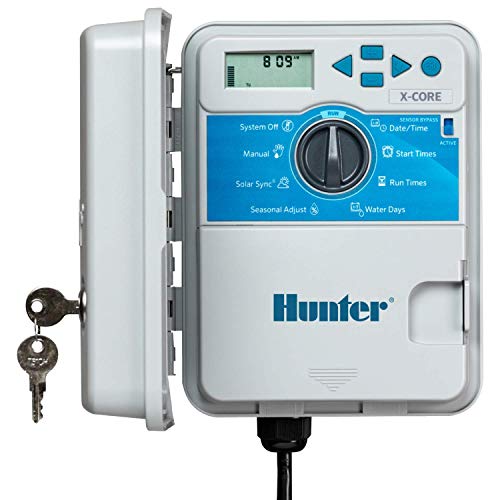
For a small system where the owner values a long-established dial layout, the X-Core keeps programming at the controller and avoids a connected account. Hunter lists four-station models in its X-Core line, with outdoor cabinets as well as indoor variants. In the US outdoor configuration, the model code and transformer arrangement distinguish the enclosure from the plug-in indoor version; inspect that detail on the specific listing before ordering. Three independent programs with four start times per program create room for different watering days, while a manual station run helps confirm a valve during service. Seasonal adjustment and a programmable rain delay are also useful for changes made at the unit. Those controls are straightforward, but they still require the owner to understand which program and start time affect each area.
The four-station X-Core is not a network controller. Its value comes from familiar controls, a defined outdoor configuration, and compatibility with common residential valve systems. Hunter also offers optional sensor accessories within the product family, so check the exact sensor connection and model instructions if a rain sensor or solar adjustment is part of the plan.
A small controller can be the right choice for an established landscape, yet the limited station count deserves an honest check. If a new side-yard valve or separate drip circuit is already in the project scope, choose a controller with enough outputs now. Replacing a timer for extra capacity later usually involves rebuilding labels, programs, and wiring documentation.
Pros
- The dial-based interface makes common schedule changes and manual checks available at the cabinet.
- Multiple programs let a compact valve map keep distinct watering routines without phone setup.
- The outdoor X-Core configuration provides a purpose-built cabinet for a small exterior service location.
Cons
- Four fixed stations can be outgrown quickly when the landscape gains separate beds or drip valves.
- Owners who need remote alerts or off-site schedule changes will need a connected controller.
X-Core is the traditional-panel choice for a four-zone system whose caretaker wants the schedule at the cabinet. Match the exact outdoor model suffix and transformer to the installation spot; the family includes versions that should not be assumed weather-ready from a product photo.
To buy this product, click here.
Installing an Outdoor Controller Without Creating New Problems
Start by documenting the current system rather than removing the old controller immediately. Photograph each terminal, record every station number, and mark the common wire, sensor leads, master valve, and pump-start connection. Then run the existing zones one at a time and write down the area each one waters. A clear map is more useful than a matching wire color when the replacement has a different terminal layout.
Before mounting, compare the new enclosure with the wall and its power source. Check clearance for the door, the conduit or cord path, and the bend radius of the field wires. Keep line-voltage wiring within the manufacturer’s requirements, and use an electrician or irrigation professional when the installation involves work beyond your experience. Do not energize the system while loose conductors or uncovered terminals remain exposed.
Once the wiring is in place, label the stations at the controller and test each valve manually. Watch for a zone that opens slowly, does not cover its intended area, or continues after the timer stops. Those symptoms can come from a valve, wire splice, pressure issue, or sprinkler head; changing a schedule will not repair the underlying hardware.
Build the first schedule conservatively. A lawn, a shaded bed, and a drip zone rarely need identical run times or watering frequency. If a slope produces runoff, shorter cycles with pauses can help water soak in. After a few runs, check the soil below the surface and adjust by zone. Broad weather-based adjustments should be reviewed against the actual condition of the property.
For app-connected models, finish pairing and account access at the permanent mounting point. Test a manual run, stop command, weather delay, and the next automatic start. If the system includes a helper, landscaper, or property manager, agree on who controls the account and how access can be revoked. Keep a local service path available so routine operation does not become confusing when a phone is unavailable.
Finally, add a simple maintenance note inside the door or in the property records. Include the valve map, the current schedule, accessory model numbers, and the date the controller was installed. Outdoor equipment is easier to diagnose when the next person does not have to reconstruct the wiring and programming from scratch.
Which Type of Outdoor Controller Fits Your Property?
Choose connected control for a recurring remote task
Orbit B-hyve XR, Orbit B-hyve Smart, Rain Bird ARC8, and Hunter PRO-HC make sense when someone will use remote adjustments, weather features, or a record of watering activity. Before selecting among them, compare station count, network band, touchscreen or panel access, and the account setup required. A feature that is never opened adds complexity without changing the maintenance routine.
Choose a local dial when service simplicity matters more
Hunter X2, Hunter X-Core, Orbit Easy-Set Logic, and Rain Bird ESP-TM2 keep a physical interface central to the job. The X2 and ESP-TM2 can use separate accessories for connectivity, while X-Core and Easy-Set Logic are conventional local timers. Think about who will make seasonal changes and how often; a familiar dial can be more useful than a remote dashboard that nobody checks.
Choose capacity by active valves
Four and six stations suit smaller valve maps, eight stations cover many residential layouts, and twelve or fourteen are better for properties with numerous distinct circuits. The controller should have enough outputs for installed valves and a credible near-term addition. If the plumbing layout is still being designed, coordinate the controller selection with whoever is planning the valves and water supply.
Frequently Asked Questions
Can I mount an indoor controller outside if I add a cover?
Only if the manufacturer approves an enclosure for that exact model and the installation meets its requirements for heat, moisture, power, and service access. A generic plastic box may trap heat or prevent the cover from closing correctly. An outdoor-rated version is usually the clearer choice when the controller will be directly exposed to weather.
Does an outdoor rating mean the controller can be mounted anywhere?
No. The rating applies to the enclosure and stated operating conditions, not every possible location. Avoid direct spray, standing water, obstructed access, and unsuitable power routing. Check the installation instructions for temperature and humidity limits, and leave room to open the cabinet and service the terminals.
How do I know whether I need four, six, or eight stations?
Count the valve circuits, not the sprinkler heads or planting beds. If one area is controlled by a single valve, it uses one station even when several heads are attached. Choose more capacity when a separate valve is planned soon, rather than assuming a larger number will improve water pressure or divide an existing circuit.
Will smart watering work if Wi-Fi is weak at the controller?
Remote control and online weather services need a usable connection at the installed location. Test signal at the wall before removing the existing timer, particularly if the unit sits behind a metal enclosure or in a detached structure. Some controllers retain local buttons or a schedule, but connected features can be limited when the network is unavailable.
Is a pump-start terminal enough to connect a pump?
Often the controller output is intended to activate a compatible pump-start relay rather than power a pump directly. Check the controller’s electrical limits and the relay instructions. If the installation uses a pump, have the wiring plan confirmed by someone familiar with the equipment before applying power.
Can a local controller still use a rain sensor?
Many conventional timers accept a wired rain or freeze sensor. The sensor pauses watering through a local connection, so internet access is not required. Confirm the controller has the correct input, that the sensor is compatible, and that the wiring is configured for the zones you want it to affect.
Should I buy a controller with more stations than I currently use?
A modest reserve can help if a separate valve is already planned for a new bed, lawn area, or drip system. If there is no likely addition, spare terminals mostly mean unused capacity. Keep the decision tied to a real valve plan and compare the larger enclosure, cost, and setup complexity with the benefit of having room.
Final Take
The best outdoor sprinkler controller is the one whose enclosure, power arrangement, station count, and control method fit the property as it exists. Orbit’s smart units and Rain Bird ARC8 offer connected management in outdoor-ready designs; Hunter PRO-HC adds a more service-oriented sensor and flow path; X2, X-Core, ESP-TM2, and Orbit Easy-Set Logic keep local programming central or optional.
Before ordering, verify the exact model suffix, count the valve wires, check the power route, and test network signal if an app is part of the plan. A well-matched controller makes the irrigation schedule easier to manage, but water results still depend on working valves, suitable coverage, and adjustments based on the landscape.

- Ryan
Ryan Mitchell covers sprinkler controllers, smart irrigation, and watering technology at Best Sprinkler Controllers, with a focus on clear comparisons, practical features, and helping homeowners choose the right setup for their yard.
- Best Irrigation Controllers With Rain Sensor Support November 4, 2026
- Best Sprinkler Controllers for Large Yards: 9 High-Capacity Picks November 2, 2026
- Best WaterSense Irrigation Controllers: 7 Certified Picks October 29, 2026
- Can I Replace an Old Sprinkler Controller With a Smart Controller? October 27, 2026
- Best Weather-Based Irrigation Controllers: 9 Smart Picks October 25, 2026