
Best 12-Zone Sprinkler Controllers: 9 Picks in 2026
Value:
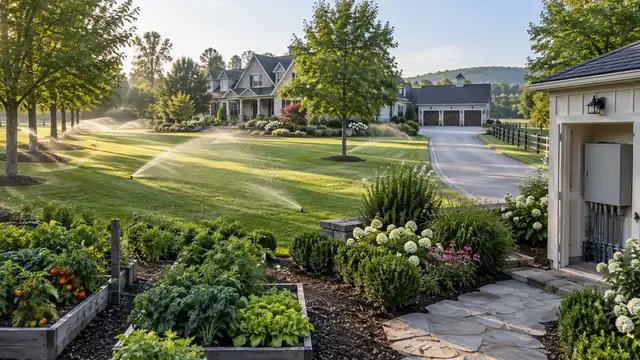
The best 12-zone sprinkler controllers make sense when the valve map has twelve independent circuits or a defined expansion plan. That might mean turf on different slopes, drip beds, a vegetable patch, and plantings with different sun exposure. If several areas still share one valve, the controller cannot separate their schedules by itself; the plumbing has to support the distinction.
The products below solve different installation problems. Some keep a screen or dial at the wall, some add app access, and one is intended for DC-latching valves at a site where ordinary AC power is inconvenient. Match the unit to the valves, mounting location, and maintenance routine first. Then weigh connected features against what the household will actually use.
Quick Answer
For a connected twelve-station installation, begin with the Hunter PRO-HC if flow and wiring alerts are priorities, the Orbit B-hyve if the owner wants a local panel plus app access, or the Netro Sprite if indoor mounting is available and its plant-oriented scheduling appeals. The Rain Bird ESP-TM2 is a better fit for someone who wants hands-on programming first and is willing to add its Wi-Fi module later.
- Hunter PRO-HC 12-Zone for Hydrawise control, a color touchscreen, and sensor or flow-monitoring options.
- Orbit B-hyve Smart 12-Zone for a weather-aware connected controller with direct controls.
- Rain Bird ESP-TM2 12-Station for straightforward dial programming with an optional connected upgrade.
- Netro Sprite 12-Zone for app-based scheduling in a protected indoor location.
Comparison at a Glance
Station count is identical across most of this list, so it does little to separate the models by itself. The table highlights the more consequential differences. Check the exact model number and included accessories on the live product page, especially where a connected module, outdoor cabinet, transformer, or valve type affects the installation.
| Controller | Control approach | Installation point to check | Most useful distinction |
|---|---|---|---|
| Hunter PRO-HC 12-Zone | Hydrawise Wi-Fi and local touchscreen | Confirm the enclosure configuration | Sensor inputs and optional flow monitoring |
| Orbit B-hyve Smart 12-Zone | App plus local panel | 2.4 GHz Wi-Fi reach and cabinet position | Connected schedules with direct controls |
| Rain Bird ESP-TM2 12-Station | Dial and LCD; Wi-Fi is an add-on | LNK2 module is separate | Three programs with four starts each |
| Netro Sprite 12-Zone | Wi-Fi and app | Indoor use unless an outdoor enclosure is added | 12 zones plus master-valve output |
| Orbit 12-Station Indoor/Outdoor Timer | Local dial and panel | Verify 12-station variant | Locking swing-panel cabinet and schedule flexibility |
| Irritrol Rain Dial RD1200-EXT-R | Local controls | Outdoor cabinet and existing wiring | Purpose-built outdoor 12-station version |
| Irritrol Rain Dial RD1200-INT-R | Local controls | Indoor mounting and external transformer | Indoor counterpart to the Rain Dial schedule |
| Hunter XC Hybrid XCH-1200 | Local controls; battery, solar, or adapter power | Requires compatible DC-latching solenoids | Useful where ordinary AC power is inconvenient |
| RAINPOINT 12-zone programmable listing | Button-based programming as listed | Confirm station count, wiring, power, and connectivity | Do not assume app or Wi-Fi from the “Smart” label alone |
What Matters in a Twelve-Station Controller
The best comparison begins at the valve box. A controller can provide twelve outputs, but the layout still needs one functioning valve per independently scheduled area, a sound common wire, and enough hydraulic capacity for the planned zones. If the property has seven valves today and no realistic expansion plan, a twelve-station unit may still be convenient, but the unused terminals do not create extra water flow or improve coverage.
Separate zones for a practical reason
More stations help when two areas should not share a watering cycle. A sunny turf strip may dry before a shaded lawn; a drip line may need a longer, slower run than spray heads; a new planting bed may need frequent short cycles while established shrubs need less. Separate valves let the schedule reflect those differences. Dividing one uniform lawn into extra stations without a distribution reason can make setup busier without solving a watering problem.
Before replacing a controller, write down each valve’s location and what it serves. Run the current stations one at a time and note weak pressure, slow valve response, or water that continues after the timer stops. Those observations help distinguish a controller issue from plumbing trouble, and they provide a useful baseline for naming the new stations.
Fixed capacity, expandable systems, and actual headroom
“Twelve stations” can mean a fixed twelve-output model, a base controller that accepts modules, or a product family sold in several station versions. Those are different purchase decisions. A fixed model is easy to size if the current valve map is stable. A modular controller may be more useful where a planned addition is already on the drawing. Buying a much larger controller solely for hypothetical future landscaping can leave the owner paying for a cabinet, accessories, or setup complexity that never gets used.
Also check the exact variant. Similar product names can cover indoor and outdoor units, different transformers, accessory bundles, or separate station counts. Read the model number on the listing and compare it with the manufacturer’s selector or manual. Do not infer the enclosure, included module, or wiring method from a generic family photo.
Decide how much of the work belongs in an app
Remote access is useful if schedules change while the owner is away, a property manager oversees several zones, or the controller’s weather adjustments are part of a deliberate water-management plan. A touchscreen or dial remains valuable for commissioning, quick manual tests, and troubleshooting. The two approaches are not mutually exclusive: several smart products retain a local interface, while the Rain Bird ESP-TM2 starts as a traditional timer and can be upgraded with a separate module.
Network features add their own checks. Confirm 2.4 GHz coverage at the actual mounting point, not from a phone beside the router. Ask who will own the account and maintain the schedule. A cloud-linked interface can simplify changes, but it should not obscure the local wiring map or make a basic station test difficult.
Give pump and sensor terminals a separate review
A twelve-station controller may have a master-valve or pump-start output, sensor inputs, or compatibility with an optional flow meter. Those terms do not guarantee that every accessory can connect directly or that the transformer has enough capacity for a particular installation. Match the controller manual to the pump relay, valve specifications, sensor type, and current wiring diagram before moving conductors.
For flow monitoring, the controller and a compatible meter are only part of the setup. The plumbing position, pipe diameter, meter orientation, and zone flow range matter too. For rain or soil inputs, check whether the sensor is wired or wireless and whether the controller can apply it to all stations or selected ones. A clear answer here is more valuable than a long feature list.
How to Choose the Right Model for Your Property
Once the station map is written down, decide which compromise would be hardest to live with. Some buyers want all controls available at the wall. Others want remote weather adjustments. A property without a convenient electrical outlet may need a controller built around batteries and DC-latching valves. The following questions separate those priorities before accessory prices or branding take over the decision.
Where will the controller actually be mounted?
Measure the wall and inspect the route to the valve wires, power, and any sensor leads. An outdoor-rated cabinet can be appropriate for an exposed location, while an indoor unit may need a dry, accessible service area. Netro explicitly specifies indoor installation unless its outdoor enclosure is used. The Hunter PRO-HC and Orbit B-hyve product families offer indoor/outdoor configurations, but confirm the exact model being sold. Do not rely on “weather resistant” in a listing if the manufacturer’s enclosure designation says otherwise.
Does the property need weather response or predictable manual schedules?
Weather-based adjustments can help a baseline schedule react to local conditions, but their usefulness depends on a correctly configured location and sensible station runtimes. In a region with watering restrictions, follow the local rules regardless of what an app proposes. A traditional unit can be a sound choice if the owner prefers a fixed plan and is prepared to make seasonal changes by hand.
For the Rain Bird ESP-TM2, Wi-Fi control requires the separately sold LNK2 module. The base unit is not equivalent to a controller with built-in app access. That separation can be attractive if the owner wants to start locally and decide about connectivity later, but the module cost and setup belong in the budget.
Are the valves standard AC or DC-latching?
This check is essential for the Hunter XC Hybrid. The XCH-1200 is a twelve-station model designed for DC-latching solenoids, with battery or solar operation and an optional 24 VAC adapter. It is not a direct substitute for a conventional timer merely because both have twelve station labels. Identify the solenoids at the valves and verify compatibility before ordering; otherwise, a controller can appear to power up while failing to operate the installed valves.
What must remain easy to service?
Think about who will adjust the timer three months after installation. A visible dial can be easier for a homeowner or technician who wants to change a start time without signing into an account. A touchscreen offers more on-device feedback. An app may make schedule edits convenient, though someone still needs to keep passwords and location settings current. Put the controller somewhere its display, cabinet, terminals, and power connection can be reached without moving stored items or standing in a wet area.
Installation and First-Season Setup
Take a photograph of the old terminals before removing a wire. Label each station by the area it waters, then mark common, sensor, master-valve, and pump connections separately. A handwritten map should travel with the property records. Terminal names and wire colors are not reliable substitutes for confirming the circuit at the valve or controller.
Check the installation manual for the exact model’s power requirements, enclosure rating, and output limits. The outdoor Rain Dial includes an internal transformer and weather-resistant cabinet; the indoor Rain Dial is a different configuration with an external transformer. Likewise, the Netro Sprite needs its own outdoor enclosure for outdoor placement. These differences affect more than appearance. They determine where the controller can be mounted safely and what must be protected from moisture.
After mounting, test one zone at a time. Watch the valves and heads long enough to notice a weak start, water hammer, poor coverage, or a valve that does not close. Record what each station does before building a complex schedule. If a pump relay is part of the installation, confirm its control wiring and operating sequence with the relay and controller instructions.
Start with a simple schedule and adjust from observed soil and plant conditions. A slope or dense soil may need cycle-and-soak behavior rather than one long run. Drip lines, shrubs, and turf should not be assigned identical runtimes simply because they share a controller. After the first few cycles, inspect coverage, look for runoff, and make one change at a time so the result is understandable.
For a connected timer, complete pairing where the controller is installed. Test a manual start and stop, verify the location used for weather data, and make sure a second responsible person can access the account if that is part of the maintenance plan. For a battery-powered hybrid, check the battery or solar arrangement and confirm the solenoid type before commissioning every station.
Which Kind of Buyer Is Each Option For?
A smart controller with an on-device display offers a different balance from a local dial timer. The list below is a quick way to match the product family to the work the owner expects it to do, not a ranking by price or station count.
- For flow and wiring diagnostics: Start with the Hunter PRO-HC, then confirm the flow meter and sensor accessories needed for the desired alerts.
- For a local panel and connected schedule: The Orbit B-hyve is worth considering if Wi-Fi is reliable at the cabinet and the owner wants app access.
- For conventional programming with an upgrade path: Rain Bird ESP-TM2 provides dial-based control; its Wi-Fi module is a separate purchase.
- For a protected indoor wall: Netro Sprite offers app scheduling, though outdoor installation needs a compatible enclosure.
- For service without an app account: Orbit’s Easy-Set Logic and the two Rain Dial configurations keep routine programming local.
- For a remote site without ordinary AC wiring: Consider the Hunter XC Hybrid only after confirming DC-latching solenoids and the power arrangement.
- For the RAINPOINT listing: Treat it as a programmable candidate, not a verified smart controller, until the exact page confirms its station count, app functions, wiring, and included parts.
Hunter PRO-HC 12-Zone
The PRO-HC is the screen-first choice for a twelve-valve property that also benefits from remote oversight. Its color touchscreen gives a technician or homeowner a way to inspect settings and start a station at the controller, while Hydrawise makes schedule changes available away from the wall. That combination is more meaningful on a landscape with distinct lawn, shrub, and drip circuits than on a small, uniform yard.
Hunter lists two sensor inputs and a pump or master-valve output on the fixed 12-station model. Those terminals create options for rain sensing and pump control, but the exact accessory and wiring plan still need to be confirmed. Flow alerts require compatible flow hardware, which is purchased and installed separately. The controller can report what a meter sees; it cannot replace correct meter sizing or a walk-through of the irrigation zones.
In daily use, the advantage is having a readable local interface alongside the connected schedule. The touchscreen is useful during commissioning, while remote tools help when a watering adjustment is needed away from home. Weather-based changes still need sensible runtimes and local restrictions, so treat the software as a way to manage a sound schedule rather than a substitute for one.
Check the exact enclosure version, power, and Wi-Fi coverage before choosing the PRO-HC. The product family includes different installation configurations, and a cabinet that fits the wiring but blocks its own door is a poor service location. Owners who will use the sensor or flow functions have more reason to accept the additional setup than someone looking for a set-and-forget dial timer.

Pros
- The touchscreen provides a useful on-device way to test and adjust stations without relying on a phone.
- Two sensor inputs and flow-meter compatibility create a path to more useful diagnostics when the matching accessories are installed.
Cons
- The exact PRO-HC enclosure and accessory configuration should be checked because the family includes more than one installation variant.
- Flow reporting requires a compatible meter and additional plumbing work rather than the controller alone.
Place the PRO-HC on the shortlist when sensor or flow monitoring will be part of the maintenance routine and a local screen matters. A simpler schedule-only yard may leave much of its connected depth unused.
To buy this product, click here.
Orbit B-hyve Smart 12-Zone
The B-hyve makes a case for itself through the way it divides routine control. A person at the cabinet can use the local panel for a manual zone test; the owner can use the app to change a schedule or pause watering without walking to the controller. That split is helpful when maintenance is shared, or when a property manager handles seasonal adjustments from elsewhere.
Orbit lists Wi-Fi and Bluetooth, weather-related scheduling, rain or freeze delay, and several program options for this 12-zone model. These functions can reduce repetitive schedule edits, but the system still needs the correct location and network connection. Test the 2.4 GHz signal where the unit will be mounted, and confirm that the specific version in the cart has the local controls you expect.
The B-hyve belongs on a larger yard whose valves already separate unlike areas. Twelve stations can keep turf, drip, and beds on their own timing, while a small valve map may leave much of the capacity idle. Pick it for the practical value of local-plus-app operation, not simply because a connected controller sounds more advanced.

Pros
- Keeping a local panel alongside app control lets a technician run a station while the owner manages schedules remotely.
- Weather-related scheduling can reduce the number of routine manual adjustments for a yard with varied exposure.
Cons
- Remote scheduling depends on a working account and network at the installation site.
- Its larger feature set takes more initial setup than a basic local timer.
A yard with twelve real valve circuits and reliable Wi-Fi gives the B-hyve room to justify its app tools. Keep the panel-based testing in the decision too, especially if more than one person maintains the system.
To buy this product, click here.
Rain Bird ESP-TM2 12-Station
Rain Bird’s ESP-TM2 begins with a dial, a backlit display, and programming at the controller. The fixed twelve-station version supports three programs and up to four start times per program. That layout is useful when the person maintaining the system wants to see the schedule and run a station without first pairing a phone or managing an online account.
Wi-Fi is an upgrade path, not a built-in feature of the base timer. Rain Bird’s LNK2 module is sold separately. Its smart-controller and WaterSense language also depends on the appropriate connected module and WR2 rain sensor combination, so check which accessories are included before comparing package prices. A bare ESP-TM2 should be evaluated as a local timer.
The dial makes commissioning fairly direct: identify a station, set its schedule, then run it and observe the valve and heads. Three programs leave room to separate turf from beds or drip, though the labels and runtimes still need to match the actual yard. Adding a module later will not correct an inaccurate station map.
For a replacement, verify the exact 12-station model, the power arrangement, and the wiring terminals against the manual. The ESP-TM2 suits an owner who values predictable hands-on operation and may want remote access later. If app control is needed on day one, include the LNK2 in the purchase plan rather than assuming it comes in the box.

Pros
- Three programs and four start times per program give separate landscape groups room for distinct schedules.
- The optional LNK2 module lets an owner add remote access later instead of replacing the base timer.
Cons
- Wi-Fi control is not included in the base unit; the LNK2 module is an extra purchase.
- The twelve-station version is fixed capacity rather than a modular expansion base.
The ESP-TM2 is a strong match for dial-first programming with a possible connected upgrade. Decide on the LNK2 before comparing totals, since remote access is an add-on rather than part of the base timer.
To buy this product, click here.
Netro Sprite 12-Zone
Netro Sprite is best judged by its mounting requirements before its app features. Netro specifies the Sprite-12 for indoor use; outdoor placement calls for a separate enclosure that protects both the controller and power adapter. A covered porch or eave does not automatically meet that requirement. If the existing timer is outside, include the proper enclosure and a protected cable route in the installation estimate.
Once mounted in a dry location, the Sprite offers phone-based schedule management through 2.4 GHz Wi-Fi, with weather and watering-rule inputs available in the app. That approach can suit someone who prefers to adjust programs remotely. It also makes network reach and account access part of ordinary upkeep, so pair the controller where it will live and make sure another responsible person can reach the settings if needed.
Twelve outputs and a master-valve connection give the Sprite room for a larger wired landscape. Its automatic scheduling still depends on accurate zone names, sensible plant groupings, and a working irrigation system. Consider it for an indoor utility wall and an app-oriented owner; exposed mounting or a preference for a local dial points elsewhere.

Pros
- Twelve zone outputs plus a master-valve output suit a larger wired landscape with a dedicated shutoff circuit.
- Phone-based schedule management is convenient for an owner who already maintains the yard through connected devices.
Cons
- The controller should not be mounted outdoors without the separate enclosure Netro specifies.
- App operation depends on a compatible 2.4 GHz network reaching the installation point.
Netro makes the most sense when a dry indoor mounting place is already available and phone-based scheduling is the preferred routine. An outdoor wall adds a separate enclosure requirement that can change the project cost.
To buy this product, click here.
Orbit 12-Station Indoor/Outdoor Timer
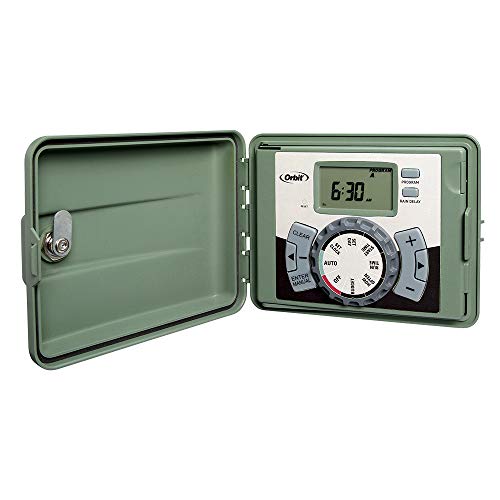
Orbit’s conventional 12-station timer keeps the schedule at the cabinet. Its swing panel and locking enclosure put the display and terminal access together, and the product family is designed for indoor or outdoor mounting. That arrangement can be welcome in a garage or service area where the router is irrelevant and a technician needs to run a valve directly.
Easy-Set Logic offers multiple programs, several start times, manual watering, rain delay, and cycle-and-soak scheduling. Breaking a longer run into intervals can help a sloped area absorb water rather than send it toward the sidewalk. Those options are most useful when the zones have distinct purposes and the schedule is labeled clearly enough for someone else to maintain.
This timer does not provide the remote schedule changes or app-based weather response found on the connected models. That is a real trade when the owner travels frequently; it is also one less account and network dependency for a household that prefers local control. Set expectations before purchase so the lack of an app does not become a surprise later.
Orbit sells the Easy-Set family in several capacities. Check that the listing is specifically for twelve stations, then compare the cabinet, transformer, and wiring instructions with the existing installation. With the right variant and an established valve map, it offers capable scheduling without asking the owner to adopt a connected workflow.
Pros
- The swing-panel cabinet keeps terminal access and local schedule controls together during service.
- Multiple programs and cycle-and-soak scheduling help separate lawn and drip routines without adding another controller.
Cons
- Owners who expect remote schedule changes will need a different model or an added connected system.
- Confirm the 12-station variant because the Easy-Set Logic family also includes smaller capacities.
Choose this Orbit when you want a capable schedule at the wall and have no need to edit it from away. Its fit depends on buying the exact twelve-station version, not a smaller Easy-Set model with a similar cabinet.
To buy this product, click here.
Irritrol Rain Dial RD1200-EXT-R
The RD1200-EXT-R is the Rain Dial version for a controller mounted outdoors. It has a weather-resistant locking cabinet and an internal transformer, with rotary controls for local programming. Those details make the enclosure and power setup central to fit: leave access for the door and lock, and route the field wires so future service does not require dismantling nearby equipment.
Rain Dial-R provides three programs and three start times per program, with calendar, interval, and odd/even scheduling options. The range can accommodate separate routines, but it rewards a written plan. Assign each station a recognizable area and avoid stacking runs so tightly that a long cycle overlaps the next one.
Rain-sensor readiness and battery backup add useful support, while the base controller remains local rather than app-driven. If the installation needs remote adjustment, this is not the model to buy on the assumption that an accessory will make the core interface equivalent to a connected timer. Its strongest reason to be here is a serviceable outdoor location and familiar direct controls.

Pros
- The internal transformer and locking weather-resistant cabinet make this version suited to a properly mounted outdoor service point.
- Three programs with three starts each can accommodate several recurring watering routines at the controller.
Cons
- The local interface has no built-in app control for away-from-home changes.
- Its outdoor cabinet needs enough clearance for the door, lock, and wiring service.
The EXT-R is a location-led choice: outdoor cabinet, internal transformer, and direct controls in one configuration. It belongs where those details fit the service point and app access is not required.
To buy this product, click here.
Irritrol Rain Dial RD1200-INT-R
Rain Dial’s INT version is the indoor counterpart, built for a protected wall and supplied with an external transformer. That makes the choice less about the shared schedule features and more about where power and valve wiring can meet safely. A garage or utility room may be a tidy replacement point, provided the controller remains accessible and the transformer can be placed according to its instructions.
The rotary interface uses three programs and three starts per program. A household can keep the turf and planting beds on different routines, then run a station locally after a repair. Because settings are visible on the device, a seasonal change does not depend on a phone or an account that may have been set up by a previous owner.
Before ordering, look at how the old timer is powered and whether the proposed indoor location has a practical wire route to all twelve valves. The external transformer is part of the installation plan, not a detail to sort out after the controller arrives. The model’s physical controls will appeal to a different owner than an app-first timer, and that distinction should be intentional.
Use the INT-R when the equipment can stay dry indoors. If the only accessible position is exposed to weather, the outdoor EXT-R is the more relevant Rain Dial configuration. The two models share a family name, but their enclosures and power arrangements are not interchangeable.

Pros
- A protected indoor mounting point keeps the display and transformer away from direct weather exposure.
- The familiar local controls support manual testing and schedule changes without setting up an app account.
Cons
- The external transformer and indoor-only location narrow where this version can be installed.
- There is no built-in connected schedule management for remote adjustments.
A protected utility room and a preference for visible, physical programming are the strongest reasons to choose the INT-R. If the controller has to face outdoor conditions, select the appropriate outdoor unit instead.
To buy this product, click here.
Hunter X-Core Hybrid 12-Station
The Hunter XC Hybrid addresses a narrow but useful situation: a controller location without convenient conventional AC power. The XCH-1200 has twelve stations and can run from batteries, a solar option, or an optional 24 VAC adapter. That flexibility can simplify a remote site, although the power source alone does not determine whether the valves will work.
Valve type is the gatekeeper. This controller is designed for DC-latching solenoids. Standard 24 VAC solenoids are incompatible, including when the controller itself is powered through the optional 24 VAC adapter. Check the markings or documentation for every valve before choosing this model; a twelve-station count does not make it a drop-in replacement for a conventional timer.
Programming remains local, with multiple programs and start times for separate routines. Compare the full setup cost, including compatible solenoids and the chosen battery or solar arrangement, with the labor of running power to the site. When the valve hardware already matches, the XC Hybrid can solve a placement problem that the other products here do not.

Pros
- Battery or optional solar power can serve a site where bringing ordinary AC wiring to the controller is impractical.
- Twelve fixed stations provide separate scheduling for a remote valve map when the system uses compatible DC-latching solenoids.
Cons
- The DC-latching solenoid requirement can make this a poor drop-in replacement for standard 24 VAC valves.
- Programming is local, so schedule changes still require access to the controller.
The XC Hybrid is compelling for an off-grid mounting point only after the DC-latching valves are confirmed. That compatibility check should happen before price or solar convenience enters the comparison.
To buy this product, click here.
RAINPOINT 12-Zone Programmable Controller
The RAINPOINT page describes a 12-zone programmable controller with manual watering, rain delay, and seasonal adjustment. Its documentation is thinner than the established controller lines in this roundup, so the section should be read as a cautious assessment of the linked model rather than an endorsement of unverified features. The available product details do not clearly establish Wi-Fi or app control.
Before treating it as a wired replacement, confirm the exact station count, output voltage, transformer, enclosure rating, valve compatibility, and what is included in the package. Look for a manual tied to the precise model number, not a general description of another timer in the same product family. Also distinguish an in-ground multi-valve controller from a faucet-mounted hose timer, since they serve different systems.
If the manual confirms twelve independently controlled irrigation stations and the installation requirements match, its listed manual watering and seasonal adjustment could cover straightforward schedule needs. The key is to verify those details before purchase instead of filling gaps with assumptions about the word “programmable” or a product headline.
Keep this option on the shortlist only if the seller or manufacturer can answer the wiring and support questions clearly. A new product can still be a legitimate candidate, but limited documentation shifts more verification work to the buyer. For an existing twelve-valve system, the better-documented alternatives offer a more predictable path when compatibility needs to be settled in advance.

Pros
- Manual watering and seasonal adjustment can make basic program changes quicker if those functions are confirmed for the exact model.
- A controller without a verified app requirement may suit an owner who simply needs local, scheduled zone operation.
Cons
- The specific listing does not clearly verify Wi-Fi or app support despite the “Smart” wording used elsewhere.
- Station count, output voltage, and enclosure details need confirmation before it can be considered a standard wired replacement.
RAINPOINT remains a conditional pick until its manual and exact product details support the planned installation. If those answers are missing, choose a model with documented valve and power compatibility.
To buy this product, click here.
Frequently Asked Questions
Is a twelve-station controller right for a yard with fewer than twelve valves?
It can be, especially if the landscape is likely to gain a bed or separate drip circuit. First count active valves and identify a realistic expansion plan. Spare terminals are convenient, but they do not improve water pressure or replace the need for independent valves. If the property is stable and has only a few zones, a smaller unit may be easier to size and install.
Does the Rain Bird ESP-TM2 include Wi-Fi?
No. The ESP-TM2 is programmed locally as sold in its base configuration. Remote access requires Rain Bird’s separately sold LNK2 module. A rain sensor is another accessory, and the manufacturer’s WaterSense smart-controller qualification is tied to the module and sensor combination. Check that both accessories are included if the listing claims a connected package.
Can I install Netro Sprite outside?
Netro specifies indoor installation for the Sprite controller. The company says outdoor placement requires its enclosure to cover the controller and power adapter. A location beneath an eave is not automatically protected to the required level, so verify the enclosure and cable-entry arrangement before mounting it outdoors.
Will the Hunter XC Hybrid work with ordinary irrigation valves?
The XCH-1200 operates DC-latching solenoids. Standard 24 VAC solenoids are a different type and should not be assumed compatible. Check the valve model and Hunter’s instructions, and include the correct solenoids in the plan if the system needs them. The controller’s optional 24 VAC adapter changes the source of power; it does not erase the latching-solenoid requirement.
What should I check before replacing an old twelve-zone timer?
Record the station map, photograph the terminals, and identify the common, sensor, pump, and master-valve wires. Then confirm the new controller’s output type, power arrangement, enclosure rating, and station count. A controller can match the number on the cabinet and still be wrong for the installed valves or mounting location.
Do weather-adjusting schedules eliminate the need to inspect the yard?
No. Weather inputs can change a baseline schedule, but they cannot spot a blocked nozzle, a misdirected head, a leaking valve, or a drip filter that needs cleaning. Review the soil and plants after schedule changes, and run each station periodically so a physical problem is not mistaken for a software setting.
Can a twelve-station controller start a pump?
Several models in this roundup provide a pump-start or master-valve output, but the wiring and electrical limits vary. Check the controller manual and the relay documentation before connecting them. Do not connect a pump load directly to a terminal unless the manufacturer explicitly specifies that arrangement.
Final Take
Choose from the valve map outward: first confirm the station count, then match the enclosure, power source, solenoid type, and service routine. For remote monitoring or flow alerts, a smart controller can earn its added setup. For a stable twelve-valve system, a clear local panel and dependable schedule may be the more useful answer. Make the decision around what the installation needs rather than treating every connected feature as an upgrade.
Before the first automatic run, test every station and keep a record of the schedule, wire labels, and any accessory configuration. A well-matched controller makes a large irrigation system easier to adjust, but it still depends on sound valves, sensible zone design, and a schedule checked against the landscape.

- Ryan
Ryan Mitchell covers sprinkler controllers, smart irrigation, and watering technology at Best Sprinkler Controllers, with a focus on clear comparisons, practical features, and helping homeowners choose the right setup for their yard.
- Best Irrigation Controllers With Rain Sensor Support November 4, 2026
- Best Sprinkler Controllers for Large Yards: 9 High-Capacity Picks November 2, 2026
- Best WaterSense Irrigation Controllers: 7 Certified Picks October 29, 2026
- Can I Replace an Old Sprinkler Controller With a Smart Controller? October 27, 2026
- Best Weather-Based Irrigation Controllers: 9 Smart Picks October 25, 2026