
WiFi vs Non-WiFi Sprinkler Controllers: Which Is Better for Your System?
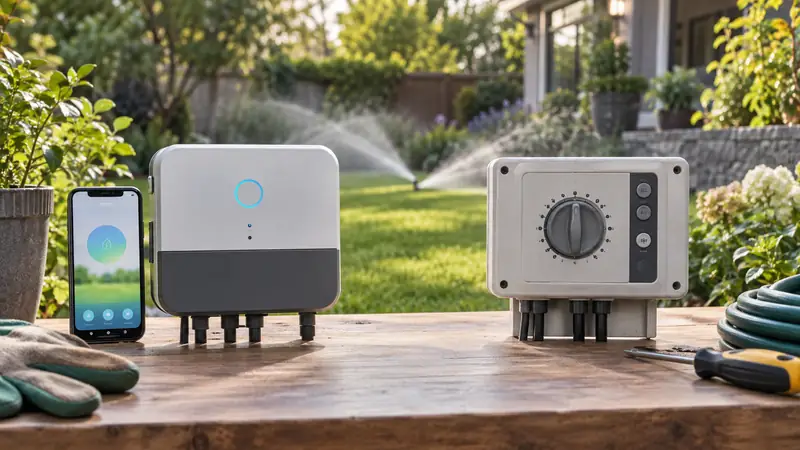
WiFi vs non-WiFi sprinkler controllers is a choice between connected convenience and simpler local operation. A WiFi model can let you review schedules away from home and use internet-based weather features, while a conventional timer can be a better fit when you want predictable controls without an app or router. Neither type is automatically the better watering system. The right fit depends on how you manage schedules and what happens when the network is unavailable.
What WiFi adds
A connected controller can make schedule changes easier when you are away, send alerts, and use local weather data to adjust or skip watering. Those features can be useful if your landscape changes through the season or you travel often. They also depend on a working account, compatible phone or browser, a suitable WiFi signal, and the controller’s cloud service.
Check the network requirements before buying. Some models require 2.4 GHz WiFi and have trouble in a metal cabinet, detached garage, or far corner of a large property. A controller that cannot stay connected may still run saved programs, but the app and live weather functions can be limited.
If remote scheduling and weather-based adjustments are priorities, our guide to the best WiFi sprinkler controllers compares models by station count, local controls, and installation requirements.
What a non-WiFi controller still does well
A standard controller can run zone schedules without internet access. You set the start times, watering days, and runtimes on the device, often with a dial, display, or buttons. Add-on rain sensors are available on many models, so “non-WiFi” does not necessarily mean every watering decision must ignore local conditions. Verify how the particular model accepts sensors and what its schedule can do.
Local controls are useful for someone who rarely changes programs and prefers not to rely on a phone app. The tradeoff is that remote changes, phone alerts, and connected weather adjustments may not be available. You may need to open the controller and make a change at the wall.
For controllers that keep everyday scheduling at the wall, see our comparison of the best non-WiFi sprinkler controllers, including models with optional connectivity upgrades.
Offline behavior is model-specific
WiFi controllers differ in how much they store locally. Rachio says its controller continues a saved fixed schedule during a WiFi outage, while weather-based features stop updating. Its support documentation also distinguishes fixed schedules from its dynamic Flex schedules, which have different offline behavior. Orbit’s B-hyve support says previously running custom programs continue offline, while remote app control and weather updates are unavailable. Read the offline instructions for the exact model rather than assuming that “smart” means the same thing across brands.
For a home with intermittent internet, ask two practical questions: will the controller keep the next watering event already stored, and can you start or stop a zone locally if the app is unavailable? If local buttons matter, confirm they exist on the model you are considering.
Side-by-side differences
| Need | WiFi controller | Non-WiFi controller |
|---|---|---|
| Change schedules remotely | Usually available through a compatible app or web account | Usually requires access to the controller |
| Use internet weather data | Often supported, subject to network and service availability | Not through an online service; a compatible local sensor may still be an option |
| Run a saved schedule during an outage | Often possible, but behavior depends on the model and schedule type | Normal operation does not require WiFi |
| Setup effort | Includes network pairing and app configuration | Usually focused on local programming |
| Best fit | Owners who value remote changes, alerts, or connected adjustments | Owners who want straightforward on-device scheduling |
Choose around your routine
WiFi is most valuable when you will use remote access or weather tools, not simply because the controller has a smart label. A busy household may appreciate changing a schedule after new sod is installed or pausing watering during a trip. Someone who sets a stable program in spring and rarely touches it may prefer the directness of a basic timer.
Also consider the full irrigation system. Both controller types still need enough stations, compatible valve outputs, and the right sensor or pump connections. A WiFi connection cannot correct an oversized zone or a miswired valve. For any controller, station count and proper scheduling matter more than the feature list.
A simple buying rule
Choose WiFi if app access and online weather adjustments solve a real management problem and the installation location has dependable network coverage. Choose a non-WiFi controller if local programming covers your needs and you would rather avoid account, router, or cloud dependence. If you prefer the connected option, confirm its offline schedule behavior and local controls before replacing a working timer.

- Ryan
Ryan Mitchell covers sprinkler controllers, smart irrigation, and watering technology at Best Sprinkler Controllers, with a focus on clear comparisons, practical features, and helping homeowners choose the right setup for their yard.
- Best Irrigation Controllers With Rain Sensor Support November 4, 2026
- Best Sprinkler Controllers for Large Yards: 9 High-Capacity Picks November 2, 2026
- Best WaterSense Irrigation Controllers: 7 Certified Picks October 29, 2026
- Can I Replace an Old Sprinkler Controller With a Smart Controller? October 27, 2026
- Best Weather-Based Irrigation Controllers: 9 Smart Picks October 25, 2026