
Best Non-WiFi Sprinkler Controllers: 9 Reliable Offline Picks
Value:
Best Non-WiFi Sprinkler Controllers are for people who want the irrigation schedule to live at the controller, not behind a router or phone account. That can be a deliberate choice: a property with a stable valve map, an owner who prefers physical controls, a weak signal near the garage, or a second home where local operation should remain simple. The important distinction is that “offline” describes the base control path. Some timers on this list have optional Wi-Fi modules, while others remain local by design.
Capacity is only half the buying decision. A four-zone timer can be the better choice for a small yard if each valve has a clear purpose; a six- or eight-station model is more useful when separate lawn, bed, and drip circuits need different schedules. The controller should also match the mounting location, valve voltage, sensor wiring, and the person who will make seasonal changes. This guide compares those practical differences instead of treating every local timer as interchangeable.
Quick Answer
For the simplest local interface, look at Hunter X-Core or Rain Bird SST, depending on whether you prefer a dial-based program layout or per-zone settings. Hunter X2 is a strong offline timer with a separately sold WAND upgrade if needs change later. For a larger outdoor valve bank, Irritrol Rain Dial gives you twelve stations and on-site programming.
- Hunter X-Core 4-Zone for a small valve map and familiar dial operation.
- Hunter X2 6-Zone for offline use with a documented optional connected upgrade.
- Rain Bird SST600IN for six zones programmed one by one in a protected indoor location.
- Irritrol Rain Dial RD1200-EXT-R for a twelve-station outdoor system managed at the cabinet.
Comparison at a Glance
Several products share local buttons or dials, but the scheduling format and placement limits are different. Use the table to narrow the field, then check the exact model number and manual before ordering; related product families often include indoor and outdoor versions or multiple station counts.
| Controller | Stations | Offline operation | Important fit check |
|---|---|---|---|
| Hunter X-Core 4-Zone | 4 | Local dial; no built-in Wi-Fi | Indoor/outdoor version and power configuration |
| Hunter X2 6-Zone | 6 | Local at the faceplate | WAND is optional, not part of the basic offline setup |
| Orbit 4-Station Indoor/Outdoor Timer | 4 | Local panel | Confirm exact model and enclosure |
| Orbit 6-Station Indoor/Outdoor Timer | 6 | Local panel | Confirm six-station variant and valve wiring |
| Orbit Easy-Set Logic 6-Station | 6 | Local swing-panel timer | Program slots, cycle-and-soak, cabinet size |
| Rain Bird SST400IN | 4 | Zone-by-zone local settings | Indoor-only mounting |
| Rain Bird SST600IN | 6 | Zone-by-zone local settings | Indoor-only mounting and outlet reach |
| Rain Bird ESP-TM2 8-Station | 8 | Local dial; LNK2 can be added separately | Confirm the 8-station configuration |
| Irritrol Rain Dial RD1200-EXT-R | 12 | Local controls | Outdoor cabinet, transformer, and room to open door |
What “Non-WiFi” Does and Does Not Mean
A local timer stores a schedule and runs the valves without needing a home network connection. That is different from an ordinary timer being able to use a rain sensor, solar sensor, battery backup, or pump relay. Those hardware connections can still operate locally. A rain sensor can interrupt a schedule through a wire while the controller remains offline.
It is also different from a product that can be upgraded later. Hunter X2 can accept the WAND module; Rain Bird ESP-TM2 can accept LNK2. Without those accessories, their day-to-day programming happens at the faceplate. If a listing or package includes an add-on, read the bundle carefully. Buying a model family that is “Wi-Fi capable” is not the same as receiving Wi-Fi hardware in the box.
Choose by how the schedule is built
Some controllers organize watering around several programs with their own start times. Others, including the Rain Bird SST models, let you adjust each zone’s days and start times directly. Program-based control can group several similar areas into one routine. Zone-based control makes the schedule for an individual area easier to see. Neither approach is automatically simpler; the choice depends on how many zones share watering needs and who will edit them.
For example, if front and back turf use the same schedule, program grouping may reduce duplicate setup. If every area has a different exposure or plant type, direct zone settings may be easier to audit. Keep the controller’s labels aligned with the physical map. “Zone 3” is less helpful during a repair than “north foundation bed” or “back drip line.”
Size the controller to real valves and likely changes
Count the valves, not the sprinkler heads. One valve may operate several heads, and a controller station is a single electrical output for a valve circuit. Four stations fit a compact system; six or eight can separate additional beds, slopes, or drip runs. More terminals are useful when a planned new circuit is credible. They do not turn one valve into independent watering areas or increase the flow available from the water supply.
Before replacing a timer, run each existing station and note its location. If a zone contains both spray heads and drip emitters, check whether those devices truly need the same run time. A controller cannot split them without a separate valve. This mapping step can reveal that the current controller is not the limiting factor.
Look closely at mounting and power
The SST400IN and SST600IN are indoor controllers. They belong in a dry garage, shed, or similar protected area. The Hunter X-Core and X2 families have variants with different enclosure configurations, and Orbit product families also span more than one cabinet style. The Rain Dial EXT is specifically the outdoor version, with its own cabinet and transformer arrangement. Match the exact unit to the actual wall; do not solve an indoor-only rating with an unapproved cover.
Also confirm the transformer, wire reach, and accessory terminals. A timer might have a master-valve or pump-start output, but that does not mean it can power every pump directly. Follow the controller and relay instructions. If a sensor is wired, inspect whether its input is compatible and how to bypass it during troubleshooting.
Decide whether the optional upgrade belongs in the budget
The X2 and ESP-TM2 can start as local controllers and gain Wi-Fi through separate modules. This can be an advantage when the owner wants to get irrigation running first and make a connected decision later. It can also create a false bargain if remote alerts or forecast adjustments are mandatory from day one. Add the module cost, network setup, and any sensor needed for the desired feature before comparing the total with a controller that includes connected hardware.
If the goal is to avoid cloud accounts altogether, simply leave the optional module out. The base controller can still use its manual programs and compatible wired sensors. Keep expectations clear for anyone else who might maintain the property: an offline timer will not send a phone notification when a valve fails or the schedule needs attention.
How We Compared Offline Controllers
For this roundup, the decisive questions were whether the timer can run a stored schedule without Wi-Fi, how easy the local interface is to use, what station count and enclosure are offered, and whether the product requires an accessory for any function that appears in a listing headline. We also separated a true capacity difference from a model-family variation, since a 4-station and a 6-station product may share nearly all their controls while serving different valve maps.
Offline does not mean featureless. Seasonal adjustment, rain delay, local sensor input, manual start, program memory, and cycle-and-soak can all be useful without connectivity. The more useful feature is the one that solves a maintenance task on the property. A remote notification may be valuable to a manager who checks several sites; a clear faceplate may matter more to a homeowner who wants to test the back lawn after a valve replacement.
Installation Notes for a Local Controller
Before removing an old timer, take a picture of each terminal and make labels for the station wires, common, sensor, master valve, and pump relay. Do not assume the wire color or terminal position is consistent across brands. If the existing schedule is important, record its run times and watering days separately; those settings may not map directly to the new controller’s program structure.
Mount the new unit in the location allowed by its manual and keep the display reachable. Protect low-voltage conductors from strain, use suitable wire connectors, and keep the transformer and power cord out of wet areas. For indoor-only Rain Bird SST models, a garage or weather-resistant shed is the appropriate type of location. For an outdoor controller, confirm that the cabinet is closed correctly and has room for service.
Run each valve manually before programming a full week. Note which area opens, whether the heads cover the intended ground, and whether the valve closes promptly. If the zone does not behave as expected, troubleshoot the wiring or valve before adjusting the schedule. After the first few watering cycles, inspect soil and plants and make measured changes instead of loading a long generic runtime into every station.
Keep a printed schedule or a note inside the controller door if the model provides space for one. An offline timer can be resilient precisely because it does not require account access, but that makes clear records more important. Anyone responsible for the yard should know how to pause irrigation, start one zone, and restore automatic mode.
Who Is Most Likely to Prefer an Offline Timer?
- Owners with a stable valve map: A local timer can run the same proven schedule through the season with occasional manual adjustments.
- Homes with weak Wi-Fi near the irrigation panel: Local programming avoids making routine watering depend on a signal that does not reach the cabinet.
- People who prefer a physical service point: A dial, buttons, and a display are available at the wall for a quick test or seasonal change.
- Secondary properties: Someone on site can manage schedules without needing to sign in to the owner’s connected account.
- Buyers who may want an upgrade later: X2 and ESP-TM2 retain optional Wi-Fi paths, but those modules need a separate purchase and setup.
Hunter X-Core 4-Zone
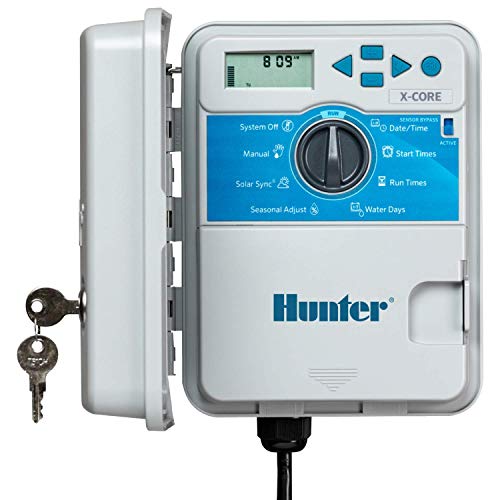
The X-Core makes sense for someone who wants the timer to behave like a timer. Its dial and display keep programs, start times, and manual station tests on the controller, with no account, router, or phone setup required. The four-station version suits a compact layout such as a front lawn, a rear lawn, and two separate planting areas, provided that is how the valves are actually divided.
Hunter specifies three independent programs with four start times per program, station runtimes up to four hours, seasonal adjustment, and a programmable rain delay. Those options allow different schedules for areas that dry at different rates. A start time schedules a program; it does not make extra valves or compensate for a poor hydraulic layout, so begin with a clear map of what each station waters.
The family is sold in indoor and outdoor versions, but the model suffix matters. Hunter’s documentation distinguishes indoor cabinets from outdoor cabinets, so check the exact listing and power arrangement before replacing an existing timer. The X-Core can accept compatible sensors and the optional Solar Sync system for local weather adjustment, yet its base operation remains local rather than Wi-Fi controlled.
That simplicity is its appeal and its limit. Owners who want a physical control point and a stable schedule can make ordinary changes without an app. Anyone expecting remote notifications or connected schedule edits should move to the X2 with its optional WAND module or choose a controller with connectivity already included.
Pros
- Three programs and four starts per program let different planting areas keep separate schedules without an app.
- The on-device dial and manual controls make a station test possible at the controller.
Cons
- This fixed four-station model can become restrictive if the property adds valves beyond its current plan.
- There is no built-in Wi-Fi for owners who need schedule changes while away.
If the four valve circuits have been stable for years, X-Core’s no-network control is a sensible fit. The main filters are size and version: this is a four-station model, and an exposed location requires Hunter’s outdoor cabinet configuration.
To buy this product, click here.
Hunter X2 6-Zone
Hunter X2 is a useful choice when the owner wants a conventional faceplate today but would like to preserve a route to remote management later. Used without WAND, the six-zone model is programmed at the controller and can run independently of home internet. Hunter sells WAND as a separate Wi-Fi option that connects X2 to Hydrawise, so a standard X2 purchase should not be described as a Wi-Fi controller.
The six stations leave room to separate lawn, beds, and a drip branch without moving into a much larger controller. The dial and backlit screen keep the programming visible during setup and service, and the product family includes fixed station counts rather than an expandable base. Match the six-zone version to the valve list and check indoor/outdoor details for the exact configuration.
The upgrade path is practical only if it matches how the property will be maintained. A homeowner who values offline operation can leave WAND out and keep using the X2 locally. If a future owner wants app access, the added module, Wi-Fi setup, and Hydrawise account become part of the project. Choose the controller for the operating style it will actually use, not for a hypothetical upgrade that may never be bought.

Pros
- The X2 runs locally as sold, so a six-zone system does not need internet to follow its schedule.
- The separate WAND option preserves a documented upgrade path for owners who later decide remote access is worth adding.
Cons
- The connected WAND module is a separate purchase, so remote features are not part of the base offline setup.
- The fixed six-station capacity leaves no expansion path through plug-in station modules.
Think of the six-zone X2 as a complete local timer with a documented upgrade route, not a Wi-Fi purchase. WAND is worth adding only when remote access has a clear job; otherwise, the offline controller already covers the schedule.
To buy this product, click here.
Orbit 4-Station Indoor/Outdoor Timer
A four-station timer is a better match than a six-zone unit when the valve map is small and unlikely to change. Orbit’s basic indoor/outdoor timer puts the controls at the cabinet and keeps routine operation independent of internet access. The wall panel can be a convenient service point in a garage or protected utility area, while the outdoor cabinet suits a location near the irrigation wiring if the exact model is rated and mounted accordingly.
Orbit’s conventional underground timer family supports independent watering programs, manual station runs, and a rain-delay feature. For a small yard, the practical gain is being able to keep the lawn separate from a flower bed or drip circuit, rather than assigning unlike areas the same runtime. Four available valves impose a real ceiling, so think through future garden additions before choosing the smallest size.
There is no app to pair and no Wi-Fi feature to maintain on the base timer. That suits a buyer who wants the schedule edited where the controller is installed. It also means an owner away from the property needs someone on site to make a change after an unexpected weather shift or service call.
Before buying, match the station version and cabinet to the installation. Product listings in this family can offer several capacities under a related product name. Confirm the model number, transformer arrangement, and wiring instructions rather than relying on a family photograph. This one belongs on a short list for a straightforward four-valve replacement, not for a yard whose plan already exceeds four circuits.

Pros
- Four local stations keep a compact valve map simple to schedule and test at the cabinet.
- The indoor/outdoor family can match a protected garage or a properly rated exterior mounting location.
Cons
- A four-zone limit leaves little room for a planned drip branch or additional planting area.
- Local-only changes require someone to reach the mounted controller.
A settled four-valve layout can use every output here, but that small capacity becomes restrictive if another independent circuit is planned. For on-site maintenance, the Orbit is straightforward; confirm the exact model and cabinet before installing it outdoors.
To buy this product, click here.
Orbit 6-Station Indoor/Outdoor Timer
For a six-valve system, this Orbit indoor/outdoor timer takes the same direct approach but leaves two more circuits available than the four-station version. Those extra outputs can keep a side yard, established shrubs, and a new planting bed on separate schedules instead of squeezing them into an already busy program. The value depends on a real valve plan, not the number printed on the front.
Local controls make commissioning easy to understand: set the schedule at the wall, then run each zone manually to confirm the valve and sprinkler heads respond. Orbit’s residential timer family also offers rain delay and more than one program, which helps when the lawn and drip areas should not share a cycle. A separate control panel is useful for service, though it means the owner must visit the unit to make changes.
Do not mistake this for B-hyve. The indoor/outdoor timer in this entry is the conventional, non-connected product. It does not use a phone app for remote changes or depend on a network to execute its programmed schedule. That operating boundary can be reassuring for a second home or a yard managed by someone who prefers buttons and a display. Connection and placement deserve a close look. This model uses a fully local control path and is intended for indoor or outdoor installation. Check the wall, transformer, wire length, and the controller manual before installation. A controller that fits the valve map still needs a clean electrical and physical setup.

Pros
- Six stations offer room to separate unlike areas that would otherwise share one watering routine.
- A local display and manual run keep maintenance available when the network or router is not part of the job.
Cons
- The larger capacity adds unused terminals if the property only has a few working valves.
- Owners who want connected weather adjustments need a different product or a separate smart system.
Six outputs earn their keep when separate watering areas need separate runtimes and someone will make changes at the controller. That gives the Orbit a useful middle size without adding smart-system setup to a local schedule.
To buy this product, click here.
Orbit Easy-Set Logic 6-Station
Orbit Easy-Set Logic is another local-control product, but the emphasis is on a guided, readable setup rather than app access. Its swing panel exposes the terminal strip while keeping the display and program controls on the door. That layout is handy during replacement work because wiring and schedule checks happen in the same place, without reaching behind the enclosure to change a setting.
Orbit’s documentation describes three schedule programs, multiple start times, manual watering, rain delay, and cycle-and-soak timing across the family. Stacked runtimes run sequentially rather than energizing every valve at once, which is a relevant detail on a six-zone home system. The 6-station model gives a little spare capacity for a property with a realistic valve addition in mind.
The cabinet is intended for indoor or outdoor installation, but “outdoor” does not remove the need for a sound mounting location and correct wiring. Check the transformer and relay arrangements against the current installation. The control method stays local: there is no built-in network pairing, so daily operation does not depend on a cloud service.
It overlaps with Orbit’s simpler indoor/outdoor timer, so distinguish them by the exact model and the panel you prefer. Easy-Set Logic has a swing-panel layout and more explicitly documented program and cycle-and-soak controls. Buyers who do not need the extra scheduling flexibility can keep the decision simpler and compare the basic timer’s price and station fit.

Pros
- The swing panel makes terminal checks and local adjustments easier to reach during a replacement.
- Cycle-and-soak and stacked runs help the owner organize a schedule without running several valves together.
Cons
- The Easy-Set Logic panel is more involved than a one-zone-per-knob design for an owner seeking the simplest interface.
- This base timer has no remote app control for changes made away from the property.
The swing panel and program options are what distinguish Easy-Set from Orbit’s simpler local timer. They help when the owner will use the scheduling controls; with one fixed routine, the added interface is another thing to learn.
To buy this product, click here.
Rain Bird SST400IN
The SST400IN is the smallest controller in this comparison and one of the clearest choices for a four-valve installation inside a garage or shed. Its zone-based interface asks the user to set each area’s schedule directly, rather than first learning a multi-program structure. Rain Bird includes a transformer and a six-foot power cord, and the manufacturer labels this model for indoor placement.
Each zone can have its own watering days and up to four start times, with options such as custom days, odd/even days, and cyclic schedules. That arrangement is useful when a lawn and a small bed need different frequency. Seasonal adjustment and a rain delay help with broad changes, though the timer itself does not fetch weather or make online decisions. Rain sensor compatibility and support for a master valve or pump-start relay can matter more than the small screen for some installations. Confirm the accessory wiring before purchase. The SST400IN remains a local controller; it does not have built-in Wi-Fi, and the listing specifies indoor use only. Put it somewhere dry and easy to read.
Choose this unit when simplicity and four independently managed areas describe the job. It is less appealing if the valve map is close to six zones or the owner wants the controller mounted outside. The value is in reducing the programming burden for a compact indoor installation, not in adding remote features.

Pros
- Zone-based programming makes it easier to give four different landscape areas their own watering days.
- One-touch seasonal adjustment and rain delay help the owner change a schedule at the wall as conditions shift.
Cons
- The SST400IN is indoor-only, so it needs a dry garage, shed, or similar protected position.
- Its local schedule does not receive live weather data or send remote alerts.
The four-zone SST400IN fits a protected service space and a caretaker who wants to edit each area directly. An outdoor mounting point or a likely fifth zone should move it off the shortlist.
To buy this product, click here.
Rain Bird SST600IN
Rain Bird’s SST600IN follows the zone-by-zone approach of the SST400IN but controls six valves. That gives a modest landscape more room to separate turf, shrubs, and drip while keeping each zone’s schedule visible through the controller’s lighted indicators. For an owner who does not want separate A/B/C program logic, direct per-zone setup can feel more intuitive.
The manufacturer lists up to four watering times per zone, one-touch seasonal adjustment, a rain delay of up to 72 hours, sensor compatibility, and a master-valve or pump-start connection. Those are hands-on tools: they help the owner shape and pause the schedule at the wall, not receive remote alerts or automatically react to a forecast.
Placement is an important limitation. Rain Bird specifies the SST600IN for indoor use in a weather-resistant location such as a garage or shed. The included transformer and cord also mean the outlet and cable route should be part of the layout. If the only workable point is outdoors, a suitable outdoor model is a better fit than an improvised cover.
The six-zone SST makes sense when each valve has a distinct job and the controller can live in a dry service area. Choose its four-zone sibling when the extra outputs would sit unused. Either way, name the stations clearly so the simplified interface stays useful after the original installer has left.

Pros
- Six independently scheduled zones provide useful separation for a modest mixed landscape.
- Indoor-only placement keeps the display and included transformer in a protected service location.
Cons
- The indoor-only rating rules out a direct exterior mounting without a suitable protected location.
- Its local controls do not provide remote scheduling or notifications.
Step up from the SST400IN when five or six valves are already wired or on the near-term plan. Its direct zone settings remain local and indoor-only, so the additional capacity is the practical difference, not a new control method.
To buy this product, click here.
Rain Bird ESP-TM2 8-Station
The ESP-TM2 is for the buyer who wants a familiar dial, backlit display, and straightforward local programming, with a separate option to add remote access later. The 8-station model can handle a larger residential valve map than the smaller Rain Bird SST timers. Its base function is not dependent on Wi-Fi, and ordinary programming and manual watering remain available at the controller.
Rain Bird specifies three programs with up to four start times per program. That gives the owner a way to group zones with similar needs, such as separate lawn areas and foundation beds, while preserving distinct schedules where necessary. The dial format also makes manual tests and seasonal changes visible to someone standing at the unit.
LNK2 is a separate module. If it is not installed, the unit stays offline; if connected features are wanted later, the module can add app control and weather information. That upgrade path is a useful distinction for this roundup: it gives the owner a conventional timer now without pretending the product has built-in Wi-Fi.
For an eight-valve replacement, the station count gives this dial model a useful role above the smaller indoor timers. It can preserve independent zones for several parts of the yard while keeping setup at the faceplate. Run each zone manually before committing to schedules, especially if the previous timer had a different program layout.
Confirm the exact 8-station model and installation configuration. The ESP-TM2 family includes several capacities and indoor/outdoor versions depending on market and model. A dial controller still needs a labeled valve map, dry wiring, and the correct supply. Consider this model if the station count is right and the owner wants control at the panel, with an optional connected accessory kept separate from the base purchase.

Pros
- Eight stations offer more room than a four- or six-zone timer while keeping basic operation at the dial.
- The optional LNK2 module can be added later without replacing the base controller.
Cons
- Wi-Fi and app access require a separately purchased LNK2 module.
- The 8-station version is fixed capacity, so future valve expansion requires a different controller plan.
ESP-TM2 stands apart from the offline-only timers because an LNK2 module can add remote control later, while the base continues to work at the dial. Keep that module separate in the budget and confirm the exact enclosure before choosing it for an outdoor wall.
To buy this product, click here.
Irritrol Rain Dial RD1200-EXT-R
Rain Dial RD1200-EXT-R brings twelve stations to the offline side of the list. That capacity is more relevant to a larger property or a site with multiple lawns, beds, and drip branches than a small yard. The outdoor model has a locking, weather-resistant cabinet and an internal transformer, so it is designed around a controller that can sit near the irrigation wiring.
Programming is entirely available at the controller. Rain Dial supports three programs and three start times per program, with watering by chosen days, interval, or odd/even dates. Those options can help with separate landscape groups and local watering rules. A rain sensor can be added, but the base unit does not need Wi-Fi or an app to run the schedule.
The outdoor cabinet is more than a weather detail. It determines whether the service display can be read, the door can open fully, and the existing wire bundle reaches without strain. A controller that is hard to access tends to discourage the very manual checks that make offline operation dependable.
Its physical interface is the main attraction for an owner who values a straightforward service routine. A manual run lets someone check a valve at the property; the lockable outdoor case puts the controls and wiring behind a door. Keep room for the cabinet to open and verify the station map before moving wires.
Do not choose the 12-station model solely for unused headroom. It is larger than the other offline timers here, and its programming has more options to manage. The better fit is a working twelve-valve system that needs outdoor local control and a clear way to keep its schedules under household or groundskeeper supervision.

Pros
- Twelve stations and local programming fit a larger property that needs many independent circuits.
- The locking outdoor cabinet and internal transformer keep the controls near an exterior valve-wire route.
Cons
- The larger Rain Dial has more schedule options to set and maintain than a basic four-zone timer.
- There is no built-in app interface for remote schedule adjustments.
Rain Dial makes sense when twelve valves and local outdoor programming justify a larger cabinet. Its on-site controls are the point; leave enough room to service the door and verify the wire map before moving conductors.
To buy this product, click here.
Frequently Asked Questions
Will these controllers keep watering if the internet goes down?
The base controllers in this roundup run their stored schedules locally. The Hunter X2 and Rain Bird ESP-TM2 also work without their optional WAND or LNK2 modules installed. If a connected module has been added, confirm the manufacturer’s offline behavior and keep the programmed schedule intact rather than assuming every remote feature remains available.
Is the Hunter X2 a Wi-Fi controller?
Not in its standard configuration. The X2 is programmed at the faceplate and can run without a network. Hunter’s WAND module is a separate accessory that connects the controller to Hydrawise. Check the box contents and include the module only if remote management is part of the plan.
Which Rain Bird model is meant for outdoor installation?
The SST400IN and SST600IN are indoor models and need a weather-resistant location. The ESP-TM2 family has configurations for different mounting situations, so verify the exact model number and enclosure instructions. The Rain Dial RD1200-EXT-R is the outdoor version listed here.
Can a local timer still use a rain sensor?
Several models support a compatible wired rain sensor or sensor input, but the accessory and setup vary. A rain sensor can pause watering without an internet connection. Confirm the controller’s sensor terminals and whether it allows the input to be bypassed for selected zones.
How do I decide between four and six stations?
Count the working valves and name the areas each one serves. Four stations may be enough for a compact front and back lawn with two beds; six can separate additional drip or planting areas. Leave room for a likely valve addition, but do not buy capacity as a substitute for planning the irrigation layout.
Do non-Wi-Fi controllers adjust watering for weather?
Some can use a separately wired sensor, and certain models support add-on weather hardware. A standard offline schedule will not fetch a forecast by itself. If automatic forecast adjustments are important, look for a documented compatible module and price it with the controller.
Final Take
Choose the controller that fits the valve map, the wall, and the household’s comfort with programming at the unit. A physical interface can make service straightforward, while a separate optional module keeps future connectivity available on selected models. Check the exact station count, enclosure, and any accessory before purchasing.
Once installed, write down the zone names and keep the schedule near the controller. Test each circuit, watch the landscape after watering, and revisit seasonal settings as conditions change. A timer can run locally for years, but reliable results still depend on clear wiring, healthy valves, and a schedule that matches the yard.

- Ryan
Ryan Mitchell covers sprinkler controllers, smart irrigation, and watering technology at Best Sprinkler Controllers, with a focus on clear comparisons, practical features, and helping homeowners choose the right setup for their yard.
- Best Irrigation Controllers With Rain Sensor Support November 4, 2026
- Best Sprinkler Controllers for Large Yards: 9 High-Capacity Picks November 2, 2026
- Best WaterSense Irrigation Controllers: 7 Certified Picks October 29, 2026
- Can I Replace an Old Sprinkler Controller With a Smart Controller? October 27, 2026
- Best Weather-Based Irrigation Controllers: 9 Smart Picks October 25, 2026