
Best 4-Zone Sprinkler Controllers: 9 Picks in 2026
Value:
Best 4-Zone Sprinkler Controllers are easiest to choose once you count the valves rather than the sprinkler heads. Four separate valves can serve a surprising mix of lawn, border beds, shrubs, and drip irrigation, but the controller has to match the place where it will be mounted and the way its schedule will be maintained. Some four-station models are strictly indoor units; some arrive in an outdoor cabinet; others can expand if the garden grows.
The practical differences show up after installation. A local dial may be quicker for a seasonal adjustment, an app can help when the owner is away, and a modular base controller can save a replacement if one more valve is added later. This comparison separates those use cases and flags where an indoor-rated controller needs an approved outdoor cabinet rather than direct weather exposure.
All nine products below are four-station choices, but they are not interchangeable. We compare the exact system role, controls, enclosure, and accessory path so you can spend time checking the details that change the fit instead of sorting through near-identical product names.
Quick Answer
For a connected indoor controller, Orbit B-hyve 4-Zone keeps app scheduling in a compact four-station setup. Hunter HPC-400 pairs a four-station starting point with built-in Hydrawise Wi-Fi, and compatible modules can add stations as the valve plan grows, while Hunter X2 gives you a fixed outdoor-ready four-station timer with an optional connected module. Rain Bird SST400IN is worth a look if you want to set each zone directly and can mount the controller in a protected indoor space.
- Orbit B-hyve 4-Zone Indoor for connected schedules in a protected utility space.
- Hunter HPC-400 Hydrawise Controller for built-in app control and a four-station base that can expand.
- Hunter X2 4-Station for local dial programming with an optional path to Hydrawise.
- Rain Bird SST400IN for direct zone-by-zone setup in a dry indoor location.
Four Zones: Enough for Which Yard?
Four stations are not automatically a small-system compromise. They can be a clean fit for a front lawn, back lawn, planting bed, and drip line if each circuit has a distinct valve. The count becomes restrictive when the property needs separate watering for a side strip, slope, foundation shrubs, vegetable beds, or areas with different spray types. If all four stations are already in use and a fifth circuit is in the near-term plan, compare an expandable base before choosing a fixed model.
Count valves, then map the landscape
A controller station typically energizes one valve circuit. A station may feed several sprinkler heads, so four heads do not necessarily mean four controller outputs. Start at the existing cabinet, photograph the terminals, and label each active station wire with the area it controls. Then compare those labels with what happens when each zone is run manually. This is more reliable than estimating from lot size or a sprinkler count.
The map also reveals whether two areas have been grouped simply because the old controller lacked outputs. A lawn and a drip bed may share a valve today, but they can require very different run times. A new controller cannot separate them by software alone; independent schedules need independent valves. That distinction matters before buying a controller with a larger display or more programs.
Decide whether four outputs need to stay four
If the valve plan is settled, a fixed four-zone timer can be smaller and less costly than a modular system. If a new valve is already planned, a base controller that can accept expansion may be a better long-term fit. Expansion usually requires a compatible station module and some rewiring, so confirm the precise controller family and module rather than assuming every Hunter Pro-C or every four-station timer accepts one.
Do not add a station reserve for a vague possibility. Extra terminals cannot add water flow, improve pressure, or make one existing valve behave like two. The useful question is whether the property has a credible fifth circuit and whether the plumbing, wire, and water supply can support it.
Indoor, outdoor, or indoor with a cabinet
The product label is part of the model choice. Orbit B-hyve 4-Zone and both Rain Bird four-station indoor timers in this list are intended for protected interior locations. Orbit states that its B-hyve indoor timer can be used outside when placed in its compatible outdoor cabinet. A purpose-built outdoor unit such as Hunter HPC-400, X2, X-Core, or Orbit Easy-Set Logic has a different enclosure and power arrangement.
A garage is not automatically a safe spot if it gets very hot, damp, or exposed to hose spray. An indoor controller needs a dry wall with a suitable outlet and enough room for wire entry. Outdoor cabinets still need correct mounting, a serviceable door, and protection from standing water. Check the installation manual for the exact unit instead of treating a cover as a universal fix.
Match the control method to the person who will adjust it
App control is convenient when the owner travels, shares maintenance with a landscaper, or wants to review watering away from home. It adds a wireless setup and, in some cases, an account, module, or app dependency. A local interface avoids much of that overhead. Its tradeoff is simple: someone needs to be at the unit to change a schedule or run a zone.
There are useful middle options. Hunter X2 can work locally before a WAND module is added. The HPC-400 is different from a conventional Pro-C base: Hydrawise Wi-Fi and a touchscreen are included on this four-station model. A compatible HPC face panel is a separate retrofit for certain existing Pro-C controllers, not an add-on needed for the HPC-400 listed here. Rain Bird TRU4I can take an LNK2 module. Include optional hardware in the cost and wiring plan rather than assuming it ships with the base timer.
What Matters Beyond the Station Count
Schedule logic can be more important than a large screen
Program-based timers group zones under A, B, or C schedules. That can reduce repeated entry if several areas share watering days. Zone-based controls let the owner specify each zone’s days and times directly. The latter can be easier to audit when each of four areas has a different job. Neither system is inherently better; it depends on whether the person maintaining the yard can see how one setting affects another.
Four stations also do not mean four start times. A product may offer multiple programs with several start times each, or several starts per zone. Those are different ways to schedule. If the property needs cycle-and-soak periods, check whether the timer supports them directly or whether multiple starts must be entered manually. Make sure the schedule does not accidentally overlap two stations that draw too much water at once.
Rain sensors and pump-start wiring need a compatibility check
A rain sensor can interrupt a local program without internet access, but not every unit uses the same sensor connection. A master valve and pump-start relay also have their own terminals and electrical limits. A controller’s relay output usually triggers a compatible relay rather than powering a pump directly. Confirm how the existing system is wired and whether the accessory is included or purchased separately.
When a controller supports a sensor input, check how it affects all zones and whether that input can be bypassed during troubleshooting. A sensor installed in a covered corner may not measure the rain the landscape received. Its placement is part of the system design, more than a connector choice.
Network claims should be tested where the timer will sit
For a smart model, test Wi-Fi at the controller location, not in the center of the house. Exterior walls, metal boxes, and detached garages can reduce signal. Some four-zone controllers accept only 2.4 GHz; others require a specific app or module for remote features. Bluetooth may make setup easier close to the unit, but it does not carry out internet-based weather adjustments by itself.
If a network failure would be a concern, check which operations remain available at the panel and whether the stored schedule continues to run locally. A useful local fallback can be more important than an extra app feature. Keep account ownership and access sharing clear if a contractor or second household member will maintain the system.
How We Compared These Four-Station Controllers
The comparison gives priority to fixed-versus-expandable capacity, placement rating, interface, and what must be added to get a claimed feature. Those are the details most likely to affect a replacement decision after the timer is mounted. It also distinguishes a unit that is four stations by design from a broader product family whose related models have more outputs.
We describe manufacturer-listed capabilities and practical consequences, not personal installation tests. A product’s schedule features do not determine the correct runtime for a yard. Soil texture, exposure, sprinkler coverage, plant roots, and local watering rules still matter, so the guide treats automation as a way to manage a carefully built schedule rather than a substitute for observing the landscape.
Orbit B-hyve 4-Zone Indoor
On this B-hyve, the first decision is the wall, not the app. The four-zone indoor controller belongs in a protected room such as a dry garage or utility space. App scheduling and weather adjustments are useful if the person caring for the yard wants to check a cycle while away, but they do not change the indoor rating.
Orbit says the indoor unit can be used outside inside its compatible outdoor cabinet. That adds a second enclosure, more wall space, and another access point to keep clear. If the existing wires end on an exposed wall, compare that total setup with a controller built for outdoor placement, such as Orbit’s 57894.
For a four-valve map, the B-hyve keeps schedules and remote control together in the app. Match the exact product number to the four-station version, test the Wi-Fi at the proposed location, and decide how a second household member or contractor will get access before removing the old timer.

Pros
- App scheduling gives a homeowner a way to pause or adjust four established zones without returning to the utility room.
- The compact station count avoids a larger cabinet when the valve map is settled at four circuits.
- A compatible outdoor cabinet offers a documented route for installations that cannot place the timer inside.
- Weather adjustments can ease manual schedule maintenance for a homeowner who wants a connected four-zone routine.
Cons
- The controller itself is indoor-rated, so exterior mounting requires Orbit’s compatible protective cabinet.
- Remote adjustments depend on a working network and an account that the property owner can maintain.
The B-hyve fits a household that will use remote scheduling and has a protected place for the controller. An exposed wall changes the project: include Orbit’s compatible cabinet and its service clearance, or choose a unit whose own enclosure matches that location.
To buy this product, click here.
Hunter HPC-400 4-Station Hydrawise Controller
Hunter’s HPC-400 starts with four stations, but it is already a connected Hydrawise controller. The listed four-station base includes Wi-Fi and a touchscreen, so there is no separate smart face panel to buy for this model. That distinction separates it from a conventional Pro-C controller that may be retrofitted with an HPC face panel.
Compatible station modules can expand the HPC-400 as new valves are added. Hunter lists modules in different station increments, so the final count depends on the module selected and the wiring plan. Extra capacity is an actual hardware change, not a setting in the app; map the next valve and confirm the module before treating expansion as a benefit.
Hydrawise provides remote scheduling and weather-related adjustment, while the touchscreen keeps programming and station checks available at the cabinet. A homeowner who manages watering from a phone can use both paths; a person who wants to avoid app accounts will be paying for connected features they may leave unused.
The outdoor cabinet and 120-volt power arrangement make this a more installation-specific replacement than an indoor plug-in timer. Check the outlet or hard-wiring requirements, clearance for the cabinet, and reach of the existing field wires. Its modular design pays off when the landscape is likely to gain circuits, rather than for a settled four-valve map.

Pros
- The four-station outdoor base can grow with compatible expansion modules when a planned valve addition becomes real.
- The internal transformer keeps the power arrangement integrated in the outdoor cabinet.
- Built-in Hydrawise Wi-Fi and touchscreen provide remote scheduling and local access without an extra face panel.
- Hydrawise weather adjustments can reduce repeated calendar edits when conditions shift across the season.
Cons
- Expansion requires a separately purchased station module and is not included in the four-station base.
- The larger modular cabinet may be more controller than a small, fixed four-valve yard needs.
Expansion is the reason to pay attention here, and Hydrawise is already part of the HPC-400 rather than a later face-panel add-on. It is well suited to a yard that may gain valves; a settled four-zone layout may not get enough from the modular hardware to warrant the larger cabinet.
To buy this product, click here.
Hunter X2 4-Station
A dial and screen keep the Hunter X2 understandable at the cabinet. Seasonal startup, a repair visit, or a quick manual run can be handled at the unit without an app account. With four fixed stations, it is a clean local-control option for a compact property whose valve plan is settled.
Remote scheduling is available through Hunter’s separate WAND module, which connects the X2 to Hydrawise. The module adds cost, pairing, and network requirements; verify that it is included if the listing promises Wi-Fi compatibility and the app is part of the reason for buying.
Hunter offers indoor and outdoor configurations across the X2 family. Check the exact four-station model and enclosure before ordering. If another valve is likely, compare the expandable HPC-400 while there is still time to plan the wiring instead of discovering the fixed four-output ceiling during a later project.

Pros
- Local dial programming makes a manual check or schedule change possible at the controller without a phone.
- The outdoor cabinet suits a direct exterior installation when the selected transformer version matches the site.
- The optional WAND module lets a buyer defer connected control instead of making it part of the base setup.
- Three program groups let a four-valve property keep a lawn routine separate from beds or drip without changing the controller’s fixed capacity.
Cons
- Four fixed stations can be outgrown if the landscape gains another independently controlled valve.
- Remote access requires the separate WAND module and a compatible network connection.
The X2’s strongest argument is the dial at the controller. Price WAND only if remote management has a real job to do, and confirm the module is in the package if you expect app access immediately.
To buy this product, click here.
Hunter X-Core 4-Zone
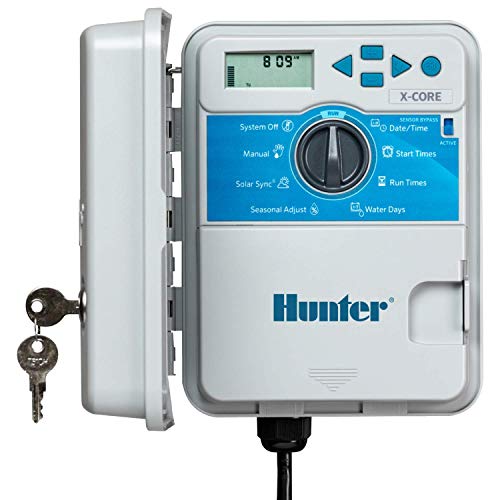
X-Core suits a yard where the program rarely changes and the person maintaining it prefers a dial to an app. Three independent programs, multiple start times, seasonal adjustment, and a programmable rain delay cover the routine scheduling jobs on a compact system.
Placement depends on the exact X-Core model. Hunter sells indoor and outdoor versions, and the four-station outdoor model is commonly identified as XC-400. Check the part number and power arrangement against the installation spot; a family photo alone does not confirm the cabinet you will receive.
A compatible rain sensor can interrupt watering, and pump-start or master-valve wiring is supported within the controller’s electrical limits. The stored schedule does not need a router, but a person must reach the unit to adjust it. Four outputs also set a hard boundary, so this is a better replacement for a known four-valve map than a system with a near-term expansion plan.
Pros
- Three program groups and four start times give a four-valve system room for distinct routines without an app.
- A manual run and seasonal adjustment keep routine service available at the dial.
- A compatible rain sensor can add a local shutoff when the matching hardware is part of the installation.
- Programmable rain delay gives the owner a simple way to pause upcoming runs at the dial after a wet spell.
Cons
- The four-station version is fixed capacity, which leaves no spare output for a planned fifth valve.
- Owners who need remote schedule changes will need a different controller or an added connected system.
For a caretaker who prefers a physical program dial and has four active valves, X-Core keeps the routine easy to follow. The part-number check is the gate: select the indoor or outdoor cabinet and power configuration for the actual mounting spot.
To buy this product, click here.
Rain Bird TRU4I 4-Station Indoor
Rain Bird TRU4I uses program groups rather than setting every zone in isolation. The display and dial let an owner work at the controller, with three programs, multiple start times, seasonal adjustment, and manual station or program operation. That middle ground can be easier to manage than an app-only setup while allowing more grouping than a basic timer.
An LNK2 module is optional for connected monitoring and control. It does not change the indoor cabinet rating, so outdoor placement still needs a manufacturer-approved protective arrangement. The plug-in supply also means the nearby outlet must be both protected and within reach.
The controller includes connections for a master valve or pump-start relay and a compatible rain or freeze sensor. Check accessory compatibility and electrical limits before planning new wiring. TRU4I is a better fit than the SST400IN when the owner prefers program groups; someone who wants to edit each area directly may find the SST layout clearer.

Pros
- Three programs and multiple start times let a four-zone schedule group areas with similar watering needs.
- The display and dial preserve on-unit operation even when no Wi-Fi module is installed.
- The optional LNK2 path allows remote monitoring to be added without replacing the base timer.
- Rain or freeze sensor and master-valve/pump-start connections can keep compatible field accessories on the same indoor controller.
Cons
- TRU4I is indoor-only and needs a dry location such as a garage or shed.
- Wi-Fi control adds the cost and setup of a separately sold LNK2 module.
TRU4I gives a small system grouped schedules, a local display, and an optional route to app control. Its indoor-only designation is decisive, so shortlist it only when a dry, protected location is available or the manufacturer approves the proposed cabinet.
To buy this product, click here.
Rain Bird SST400IN
SST400IN makes the schedule visible zone by zone. The owner can change the lawn, bed, or drip area directly without remembering which program group contains it, a helpful distinction when four circuits have different watering days. Rain Bird lists multiple start times per zone, seasonal adjustment, and a rain delay.
This is an indoor, local-control timer. It can accept a compatible rain sensor and support a master valve or pump-start relay, but it does not fetch a weather forecast or provide app access on its own. Measure the power-cord reach and verify the accessory terminals in the manual before moving wires.
For someone who likes an easy-to-audit wall interface, the direct zone layout keeps small adjustments simple. TRU4I offers a different kind of flexibility through program groups and an optional LNK2 module. Choose between those approaches based on how the schedule is organized, not on the assumption that more program labels automatically mean more useful control.

Pros
- Direct per-zone settings make it easier to inspect four different schedules without tracing program membership.
- Rain delay and seasonal adjustment support local changes as conditions shift through the year.
- Multiple start times per zone can split a small area’s watering across the day without changing its assigned days.
- Rain-sensor and master-valve/pump-start terminals help preserve those local connections when the matching accessories are already in use.
Cons
- The indoor-only enclosure needs a dry service location and a suitable outlet within cord reach.
- It lacks built-in remote access for owners who want to change a schedule away from home.
SST400IN is the clearer choice for someone who wants to adjust one area without navigating program groups. It gives up TRU4I’s optional app module and keeps control local, which is a reasonable trade in a protected service space.
To buy this product, click here.
Orbit 57894 Easy-Set Logic 4-Station
The Orbit 57894 is the outdoor-first option among the four-station timers here. Its weather-resistant cabinet has a swing panel, with programming controls at the door and wiring access behind it. That layout is useful on an exterior wall where the person maintaining the system needs to reach the terminals without removing the whole unit.
Programs A, B, and C allow separate watering plans, and overlapping run periods are stacked so the controller runs one valve at a time. That sequencing can help a system with limited flow avoid opening several valves together. It is still worth checking the pump or supply behavior and keeping program start times understandable.
The four outputs suit a small property with a complete valve map. A planned fifth circuit changes the purchase decision: the extra area needs another physical valve and a controller output, neither of which appears through scheduling software. The 57894 is fixed at four stations.
There is no app pairing or wireless upkeep to maintain. Rain delay and manual control are handled at the unit, which favors an owner who visits the controller when making adjustments. Mount the lockable cabinet where its door can swing open and the wires remain reachable after the landscaping is in place.

Pros
- The outdoor-rated swing-panel cabinet puts wiring and local program controls together at a serviceable wall location.
- Program stacking helps keep overlapping schedules from opening multiple valves at once.
- Three program slots provide separate routines without adding a phone account or network dependency.
- The at-unit rain delay lets an owner pause scheduled cycles after rain without rewriting the A/B/C programs.
Cons
- The four-station limit leaves no terminal for a fifth independent valve.
- Local programming requires someone to reach the wall-mounted timer for schedule changes.
On an exterior wall, the 57894 puts its advantage where it matters: a purpose-built weather-resistant cabinet with swing-open service access. Four outputs are a clean match for a finished small system; a fifth valve would require a different capacity plan.
To buy this product, click here.
Orbit Easy Dial 4-Station Indoor
Orbit Easy Dial is built for the person who would rather set a schedule at the wall than manage another app. Its large dial and buttons, separate A and B programs, and multiple start times cover a straightforward four-zone routine without an account or wireless setup.
The tradeoff is its indoor-only placement. Orbit says outdoor use requires a compatible protective cabinet, which adds cost and bulk; the exact cabinet should be approved for this timer. If the controller must face weather directly, compare the outdoor 57894 instead of treating the indoor label as a minor detail.
For a dry garage with a nearby protected outlet and a stable four-valve layout, Easy Dial keeps setup approachable. Manual runs help identify which area a wire controls, while a written label map makes later service easier.

Pros
- The large dial and two program groups make basic four-zone scheduling approachable for someone who wants local controls.
- The compact indoor unit suits a protected garage installation with an existing nearby outlet.
- Multiple start times can give a four-zone lawn and bed calendar more flexibility while keeping every change at the wall.
- Manual runs make wire identification practical by letting the installer observe which area responds to each station.
Cons
- The unit is not weather-rated for direct exterior mounting and needs a compatible outdoor cabinet if moved outside.
- There is no app for remote schedule changes or connected weather adjustments.
There is no app to configure and no outdoor cabinet built into this indoor timer, so its value depends on a sheltered place to mount it. With that condition met, the broad dial and two programs keep a four-zone schedule approachable.
To buy this product, click here.
HiOazo Smart 4-Zone Controller
HiOazo builds this four-zone option around app control rather than a wall display. Its product materials describe 2.4 GHz Wi-Fi, weather-related skips, and up to sixteen plans across four zones. Check the selected variant and included power adapter against the listing and instructions before counting on those features.
Standard and soak modes can divide watering into shorter runs with pauses, which may help where a long cycle runs off a slope. The app still needs accurate zone details, and a weather skip is not a substitute for checking coverage or soil conditions after the cycle.
The support question deserves more weight here than it does with a familiar controller family. Confirm valve voltage, any master-valve or pump-start support, the wiring diagram, and the warranty path for this exact model. Do that before making it the only control point for a system with equipment the documentation does not identify.
If the manual confirms the setup and a reliable 2.4 GHz signal reaches the mounting spot, HiOazo may suit a household that wants several plans in a compact smart controller. Buyers who need a physical fallback or established service documentation have easier-to-verify alternatives elsewhere in this roundup.

Pros
- Four zones and multiple app plan slots give a compact system room to organize different watering patterns without buying extra stations.
- Weather-related skips may reduce manual schedule pauses when the app and local settings are configured correctly.
- Soak mode gives the owner a built-in way to pause between portions of a programmed cycle.
- If the current manual confirms the sixteen-plan claim, the owner could keep a separate grow-in or seasonal routine available instead of overwriting the active schedule.
Cons
- App control depends on a 2.4 GHz connection and current support for the specific device and app version.
- Valve voltage, pump-relay support, and warranty terms deserve confirmation because the model’s available documentation is less extensive than the major irrigation brands’ manuals.
The plan count and soak mode are appealing only if the exact model’s manual supports the wiring already on site and the household expects to keep using its app. For a phone-managed four-zone yard, it can fit after those checks; anyone wary of support uncertainty has more established choices.
To buy this product, click here.
Replacing a Four-Station Timer: A Practical Sequence
Before taking the old controller off the wall, photograph the terminal strip and write down which area each station serves. Mark common, master-valve, pump, sensor, and unused terminals separately. If the system can still be run, test each zone and verify its label before disconnecting anything. This record reduces the chance of moving a station wire into the wrong output just because the new terminal labels look familiar.
Next, check the mounting conditions against the chosen model. For an indoor unit, confirm that the location stays dry, the outlet is within reach, and the cable does not cross a wet path. For an outdoor model, measure door clearance, look at the wire entry, and confirm the power arrangement. If the installation involves household voltage, follow the manufacturer’s instructions and bring in a qualified installer when the work is outside your experience.
Reconnect the valve wires one at a time and keep each label visible. Check the common connection and any accessory terminals before restoring power. Run one manual station at a time, then watch the valve and coverage area. If a zone does not open cleanly or does not stop when the run ends, investigate the wire, valve, or relay before changing program settings.
Rebuild the schedule around actual water needs instead of copying every runtime without review. The new interface may use programs differently from the old one. Separate sunny turf, shaded beds, and drip circuits when the watering interval differs. If a slope sheds water, shorter cycles with a pause may be more suitable than one continuous run. Adjust after checking the soil and the plants rather than treating an app recommendation as final.
For smart controllers, create the app account and pair the unit at the final location. Verify the Wi-Fi band, test a manual run, and confirm a schedule change reaches the controller. If an offline option is important, learn how to use it before the first network interruption. Keep a printed valve map and note who has account access.
How to Choose Among These Nine Models
For indoor app scheduling
Orbit B-hyve 4-Zone and HiOazo Smart 4-Zone both center the app, but they differ in documentation, mounting expectations, and feature set. The Orbit model is indoor-only unless installed in its compatible cabinet. HiOazo lists more plan slots and weather-related modes, while its wiring and support terms need careful confirmation. Match the product to the amount of support information you want before buying.
For local controls at the wall
Hunter X2, Hunter X-Core, Orbit 57894, Orbit Easy Dial, Rain Bird TRU4I, and Rain Bird SST400IN keep the physical interface central. Compare enclosure and programming logic first. X2 and X-Core have outdoor versions; 57894 has an outdoor cabinet; Easy Dial, TRU4I, and SST400IN are indoor units. Among the Rain Bird choices, SST400IN uses direct zone settings, while TRU4I uses program groups.
For growth beyond four stations
Hunter HPC-400 is the expansion-oriented choice in this list. Its outdoor base starts at four stations and can accept compatible modules. The product makes more sense if the fifth or later valve has a real place in the project. If four is likely to remain the final count, a fixed controller avoids paying for expansion hardware that may never be installed.
Frequently Asked Questions
Does a four-zone controller operate four sprinkler heads?
No. A station usually controls a valve circuit, which may feed multiple heads. Four stations can serve many heads if the valves and plumbing are arranged that way. Count the active valve wires at the controller and identify where each zone sends water before choosing a replacement.
Can one four-station timer run a lawn, beds, and drip system?
It can if those areas are divided across no more than four valve circuits and their schedules fit the controller’s programming method. A lawn and a drip bed may have different timing needs. If they share one valve, software cannot give them independent schedules until the plumbing is separated.
Which models in this guide can mount directly outdoors?
Hunter HPC-400, Hunter X2, Hunter X-Core, and Orbit 57894 have outdoor configurations or enclosures. Confirm the specific product number and power arrangement. B-hyve 4-Zone, Rain Bird TRU4I, SST400IN, and Orbit Easy Dial are indoor models and need a manufacturer-approved protective cabinet if an exterior location is proposed.
Can an expandable four-station controller be upgraded later?
Hunter’s HPC-400 starts with four stations and supports compatible expansion modules, which are sold separately. Hydrawise Wi-Fi and its touchscreen are already included on the HPC-400. A conventional Pro-C controller that needs a Hydrawise face-panel retrofit is a different product. The fixed four-station X2 and X-Core do not gain outputs through programming, so count near-term valves before ordering.
What is the difference between Rain Bird TRU4I and SST400IN?
TRU4I uses three programs with multiple start times and has an optional LNK2 connected upgrade. SST400IN lets the owner program each zone directly and remains local. Both are intended for indoor installation and can support compatible sensor or pump-related wiring, but verify the exact terminals and accessories in their manuals.
Will a four-zone smart controller keep watering if the internet is unavailable?
Behavior differs by model. Some store and run the programmed schedule locally, while remote control and online weather features need a connection. Read the exact manual, then test the local controls and stored schedule during setup instead of finding out during a network problem.
When should I choose a larger controller instead?
Choose more stations when a fifth independent valve is installed or already planned. A larger model can also make sense if expansion modules are an established part of the product family. Do not upsize merely because the yard looks large; the number of valves and their separate watering needs are what the station count must match.
Final Take
For four established circuits, the choice comes down to where the controller can be mounted, whether a local dial or app makes maintenance easier, and whether expansion is a real possibility. Orbit B-hyve and HiOazo make app scheduling central; the Hunter HPC-400 pairs Hydrawise control with a path to more stations; X2, X-Core, Orbit Easy-Set Logic, and the Rain Bird timers cover different styles of local programming.
Check the model number, enclosure, transformer, sensor and pump terminals, and network requirements before ordering. Then map the valves, test each circuit, and tune the schedule to the landscape. A well-matched four-station controller keeps a small system manageable; a careful wiring and watering plan is what makes it dependable.

- Ryan
Ryan Mitchell covers sprinkler controllers, smart irrigation, and watering technology at Best Sprinkler Controllers, with a focus on clear comparisons, practical features, and helping homeowners choose the right setup for their yard.
- Best Irrigation Controllers With Rain Sensor Support November 4, 2026
- Best Sprinkler Controllers for Large Yards: 9 High-Capacity Picks November 2, 2026
- Best WaterSense Irrigation Controllers: 7 Certified Picks October 29, 2026
- Can I Replace an Old Sprinkler Controller With a Smart Controller? October 27, 2026
- Best Weather-Based Irrigation Controllers: 9 Smart Picks October 25, 2026