
Best Sprinkler Controllers for Large Yards: 9 High-Capacity Picks
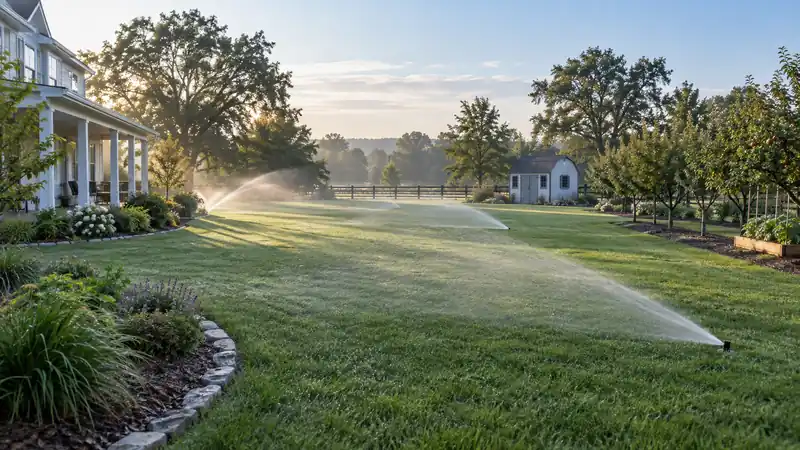
The best sprinkler controllers for large yards have to keep separate circuits manageable when the front lawn, side beds, vegetable patch, slope, and distant planting area need different run times. An old controller may have no room left for another valve. The right upgrade is the one that matches the installed wiring and gives each watering area a manageable schedule, not simply the model with the biggest number on its box.
This guide compares nine controllers with 14 to 24 stations, or a modular path to that range. Some are smart systems with weather adjustments; others retain a clear local interface and add connected control through an accessory. Two key distinctions matter throughout: station count is not acreage, and a controller’s advertised smart features cannot correct poor zoning, weak water pressure, or misplaced heads.
Quick Answer
- Hunter PRO-HC 24-Zone is the strongest fit when a single fixed 24-station controller and built-in Hydrawise connectivity suit a complex property.
- Rachio 3 16-Zone makes sense for owners who want app-led schedules and weather adjustments without adding a separate Wi-Fi module.
- Rain Bird ESP-ME3 is the flexible choice if the yard may expand, since its station count can grow with compatible plug-in modules.
- Hydro-Rain HRC 400 is worth a look when local dial controls, a large display, and connected access all have a place in the routine.
The other five models solve narrower needs, from a familiar Hunter dial interface to app-driven zone control and a configurable 16-station Hydrawise system. Use the comparison table as a shortlist, then check the model suffix and included modules against the wires in the existing cabinet.
Comparison at a Glance
| Controller | Station capacity | Connection and mounting notes | Most relevant distinction |
|---|---|---|---|
| Hunter PRO-HC | Fixed 24 stations | Built-in Wi-Fi, indoor/outdoor cabinet | High capacity in one connected controller |
| Rachio 3 | 16-zone version | Wi-Fi; use a weatherproof enclosure for outdoor mounting | App-first scheduling and weather adjustments |
| Orbit B-hyve XR | 16 stations | Indoor/outdoor design with Wi-Fi and local controls | Connected operation with an on-unit interface |
| Rain Bird ESP-ME3 | 4 to 22 stations | Indoor/outdoor; Wi-Fi requires a compatible module | Expansion by plug-in station modules |
| ImoLaza ET | Up to 16 zones | Indoor, 2.4 GHz Wi-Fi | App scheduling across a high zone count |
| Hydro-Rain HRC 400 | 8- or 16-station model | Weather-resistant cabinet; Wi-Fi and Bluetooth setup | Dial-based local control alongside the app |
| Moen Smart Sprinkler Controller | 8- or 16-zone model | Smart Water app; outdoor enclosure is a separate requirement | Optional wireless soil sensors and Moen water-network ties |
| Hunter X2 | Fixed 14 stations in this version | Indoor/outdoor; Wi-Fi through the WAND module | Conventional face controls with an upgrade path |
| Hunter HPC Hydrawise | Modular, 4 to 16 stations | Indoor/outdoor; Hydrawise connectivity | Expandable Pro-C platform with touchscreen control |
“Fixed” means the stated station total belongs to that model, while “modular” means additional stations depend on compatible modules. A listing may bundle a controller with different modules, so read the included-parts line rather than assuming the largest advertised capacity arrives ready to use.
What Makes a Controller Suitable for a Large Yard?
Station count is the first filter, but it is not a measure of square footage. A compact property with separate turf, drip beds, greenhouse lines, and a steep bank can use more valves than a broad lawn watered by a few matched zones. Think of each station as a separately wired valve or watering group. Its boundaries should follow plant needs, sun exposure, slope, soil, and sprinkler type.
A single controller can be a tidy answer when those valves are close enough for the field wiring to reach one cabinet and the transformer supports the electrical load. Long wire runs, physically separated buildings, or a remote garden can change the math. A second controller may be cleaner than extending a bundle of conductors across the property, and it can keep one failure from taking every watering area offline.
Capacity also has a cost beyond the purchase price. A fixed 24-station unit provides headroom, yet a ten-zone system will not use the extra terminals. A modular controller starts smaller and can grow, but expansion modules add expense and require a compatible model. The useful target is the number of valves the landscape actually needs, plus a modest reserve for a planned bed or future side yard.
How We Evaluated These Controllers
For this roundup, the meaningful comparisons are station capacity, the path to expansion, installation location, local controls, and what connected operation depends on. That last point includes more than whether an app exists. A buyer needs to know if Wi-Fi is built in, whether an accessory is required, and whether the controller remains usable at the cabinet when the network is down.
Large properties also benefit from service information. If a model supports a compatible flow sensor or reports wiring faults, those functions may help narrow the search when one area behaves differently from the rest. They do not replace leak inspection or a hydraulic assessment, and accessories may be sold separately. We give more weight to a feature when it changes how the system can be installed or maintained.
We did not treat zone count as a promise of performance. A controller can switch valves on schedule, but available flow, valve sizing, pipe condition, and sprinkler coverage determine whether those zones should run together or how long they need to operate. The product notes below identify where each controller fits and what to verify before buying. Product availability and package contents can change, so confirm the exact model number at checkout.
Plan the System Before Choosing a Capacity
Build a valve map, not a guess
Walk the property with the current controller schedule, if available, and mark every valve wire. Record the zone’s location, sprinkler type, plantings, slope, and any area that already has a separate drip schedule. If the labels are unreliable, test one station at a time and update the map. This small exercise catches a common problem: the controller appears short on capacity because labels or abandoned wires were never reconciled.
After the map, count active valves and identify what is likely to be added. A planned poolside bed or a new orchard row deserves a reserved station; a vague possibility of someday redesigning the yard does not necessarily justify paying for unused fixed capacity now. For a modular controller, write down the base count, module count, resulting total, and whether the extra components are actually in the package.
Keep unlike watering needs apart
Rotor zones, spray heads, and drip lines usually deliver water at different rates. Grouping them together can leave one planting dry while another sits too wet. The controller cannot repair that mismatch through a better forecast. Create zones around compatible equipment and plant requirements, then use separate run times or programs for different parts of the landscape.
A large lawn may need several zones because the available flow cannot run every head at once. That is a plumbing constraint, not a software preference. If the existing system uses a pump, master valve, flow meter, or rain sensor, check that the replacement controller has the terminals and settings needed for those devices. A controller with a high station count is not automatically a drop-in replacement for every electrical configuration.
Fixed Capacity or Expansion Modules?
A fixed 16- or 24-station model keeps the station count straightforward. Each station terminal is already part of that controller, which can make the wiring plan easier when the property uses most of its capacity today. The tradeoff is that an oversized fixed model may cost more and occupy more wall space than a smaller replacement.
Modular units approach the problem differently. Rain Bird’s ESP-ME3 starts with four stations and can grow with compatible modules; Hunter’s HPC platform also expands from a smaller base. That can be practical during staged landscaping work, although the system only reaches its advertised ceiling after the correct module combination is installed. Before ordering, compare the existing valve count with the product’s model code and the seller’s list of included parts.
There is a useful middle ground: buy the station count that covers the current valves and leave a documented route for expansion. Photograph the terminal labels, keep module model numbers with the controller manual, and note which wire belongs to each area. A future technician will thank you, and the next controller swap will be less of a detective job.
Choose the Right Place for the Controller
The cabinet location sets practical limits on the purchase. An outdoor-rated model may simplify a garage-free setup, but exposed sun, driving rain, irrigation spray, and direct heat still deserve attention. Indoor-only products need suitable protection if installed outdoors. Rachio explicitly calls for a weatherproof enclosure for outdoor use, and Moen’s instructions require its separate outdoor enclosure for an exterior installation.
For Wi-Fi models, test the signal where the controller will be mounted, not from the kitchen. A controller in a metal utility cabinet or at the far end of a detached garage may not stay online reliably. Where an app or remote notice matters, weak coverage can erase much of the convenience. A local screen or dial helps with schedule checks and manual starts, though features that rely on cloud data may still need a connection.
Consider who will use the controls. A gardener who regularly runs a single zone while checking a new plant may value a button at the cabinet. A homeowner who adjusts schedules remotely may prefer an app. Where several family members or a maintenance person need access, review account sharing and permissions before replacing a simple timer with a connected platform.
One Controller or Two?
One central unit is easiest to document when all valves share a practical wire route and operate from the same water source. Separate controllers can make more sense for a detached greenhouse, a second building, or a section with its own pump and schedule. Two devices mean two power points, schedules, and maintenance records, but they may save a long and difficult field-wire installation.
Do not combine distant valves solely to keep the equipment count low. A controller may run multiple stations in sequence, yet it cannot overcome a voltage drop on an undersized or damaged wire. If the new controller will be far from the valve box, verify conductor gauge and distance against the manufacturer’s installation limits. Where that is uncertain, an irrigation professional can check the existing wiring before you buy.
Installation and First-Season Checks
- Photograph the old wiring. Label each zone, common wire, sensor, and master-valve or pump connection before removing the old timer. Do not rely on a color scheme to identify a conductor.
- Confirm the electrical setup. Match the controller’s power requirements and valve outputs to the existing transformer, valves, and pump relay. Turn power off before moving conductors.
- Mount for access and signal. Keep the face readable and leave room to open the cabinet. For connected models, test Wi-Fi at the intended location and account for walls, metal enclosures, and detached structures.
- Run each station separately. Confirm that the correct part of the yard opens, inspect for leaks, and record any zone that has weak pressure or poor coverage.
- Set a conservative schedule. Start with the local watering rules and the needs of the plants. Adjust after checking soil and coverage, rather than increasing every zone because one area looks dry.
- Revisit after rain and heat. Weather features can skip or adjust cycles, but the schedule still needs to reflect local restrictions, new plantings, and seasonal changes.
Keep the station map and the final schedule together. On a complex property, label by place and equipment type, such as “north turf rotors” or “raised beds drip,” rather than relying on “Zone 7.” That makes troubleshooting and seasonal edits easier for anyone who inherits the system.
Which Type Fits Your Property?
- Several lawns and separate planting beds: look first at fixed 16- or 24-station models, then confirm whether all the valves can be wired to one cabinet.
- Landscaping that will expand in stages: a modular system can avoid buying every station now, provided you are willing to track and install the correct expansion modules.
- Frequent schedule changes: app-led controllers help when the person maintaining the yard is not near the cabinet, but only if the network reaches the installation point.
- Hands-on local operation: favor a clear display, dial, or physical controls for zone tests and manual operation. Smart access can be secondary.
- Outdoor placement: verify the enclosure rating for the exact model. Do not assume every controller with Wi-Fi is built for rain or direct sun.
Nine Controllers for Large, Multi-Zone Landscapes
The order below favors different ownership needs rather than treating a higher station count as a universal win. The first unit covers the broadest fixed layout; later choices trade capacity, expansion, local controls, and app dependence in different ways.
Hunter PRO-HC 24-Zone

Twenty-four fixed stations make the PRO-HC the single-box candidate for a property with a long valve list: separate turf, foundation beds, side yards, and new planting areas can remain on their own schedules. The built-in Wi-Fi and Hydrawise platform keep remote scheduling within the controller package, and the indoor/outdoor cabinet allows more flexibility than an indoor-only panel.
Hydrawise can adjust schedules using local weather data, and Hunter lists compatibility with sensors and a flow meter. That combination is useful when a large property needs more than remote start buttons, but the sensors must be compatible and assigned correctly.
A flow meter is an added component, not something to assume comes with the controller. On a large system, it can help identify unexpected flow, though it still needs a sensible response plan and correct installation. For a yard that only wants a seasonal schedule update, that extra monitoring hardware may not be worthwhile.
There is a reason not to default to the 24-station version. A fixed station total helps only when the valves and wiring support it. If ten zones are active and no expansion is planned, unused terminals do not increase pressure or improve coverage. Confirm cabinet dimensions, signal strength, and exact model code, then compare a modular controller if the station count will grow gradually.
Pros
- The 24-station fixed layout can keep a complex property’s valve schedule in one controller instead of splitting it across smaller boxes.
- Hydrawise connectivity is built in, so remote adjustments do not depend on purchasing a separate Wi-Fi module.
Cons
- Its capacity can be excessive for a property with a stable, much smaller valve count.
- Flow monitoring depends on a compatible meter and proper setup, which adds hardware and installation work.
A fixed 24-station cabinet fits a valve map that is already large and likely to stay centralized. Where most of those stations would sit unused, the PRO-HC adds size and cost without changing what the sprinklers can deliver.
To buy this product, click here.
Rachio 3 16-Zone

Split a large landscape into enough independent valves and Rachio 3 becomes less about app ratings and more about how easily the schedule can be revised. The 16-zone version is a fixed-capacity smart controller with weather-based adjustments and app management; the company says the app does not require a monthly fee. That may suit a homeowner who adjusts seasonal runtimes without standing at a small timer display.
Rachio’s 16-zone unit is intended for in-ground systems and needs a smartphone plus a reliable Wi-Fi signal at the mounting location. It is an indoor controller; outdoor placement requires a separate weatherproof enclosure. The unit uses an AC adapter, so measure the wire reach and test reception in a detached shed before removing the old timer.
Runtimes still depend on a correct valve map. A rotor area and a drip bed should not share a schedule simply because an app makes it easy to select both. The software can manage a well-laid-out irrigation system, but it cannot make mixed hardware deliver the same amount of water.
Pros
- App-based weather and seasonal schedule changes are convenient when the person adjusting irrigation is away from the controller cabinet.
- The manufacturer offers its controller app without a required monthly subscription, which keeps ongoing access straightforward.
Cons
- Outdoor mounting requires a separate weatherproof enclosure, adding another purchase and installation step.
- A weak signal where the controller sits can make the remote-first workflow frustrating.
Remote schedule edits are the reason to pick the 16-zone Rachio, provided the panel can stay indoors and the network reaches it. A dial-forward controller will feel more natural when the person maintaining the yard wants every adjustment available at the cabinet.
To buy this product, click here.
Orbit B-hyve XR 16-Zone

An on-unit interface is useful when the person checking valves still wants to work at the cabinet. The B-hyve XR pairs that local control surface with sixteen stations and an indoor/outdoor format; Orbit identifies model 57995 as its indoor/outdoor smart timer. That is a distinctive mix for a larger residential layout.
Wi-Fi and weather-aware scheduling support remote adjustments, while the station count can separate lawn sections, planting beds, and drip areas. Each station should still reflect the actual water hardware. A large panel cannot make a low-flow zone perform well when it shares a schedule with high-output rotors.
Look at the physical installation before consolidating a sprawling system. The XR needs wall space, door clearance, and a sensible route for the existing wires. If valves are spread among detached areas, compare wire distances before bringing them to one central controller. Check the model number too, since the product family includes smaller panels and hose-end timers.
Wi-Fi convenience depends on a usable signal where the controller will live. Test from that location rather than relying on the signal at the kitchen table, especially if the cabinet sits behind masonry or in a metal enclosure.
Pros
- The 16-station XR can organize a larger residential system while keeping a local control surface available for checks at the cabinet.
- Indoor/outdoor design gives more placement options than an indoor-only controller.
Cons
- The controller’s larger body needs more wall and door clearance than a compact indoor timer.
- Wi-Fi-based conveniences still depend on a usable signal at the installed location.
Sixteen stations plus cabinet-level controls is the XR’s practical combination. It suits a large property where one accessible panel can reach the valves; weak networking or a split valve map can make its dual-control approach less useful.
To buy this product, click here.
Rain Bird ESP-ME3
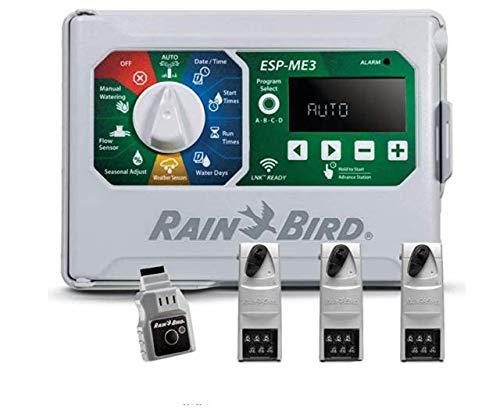
Rain Bird’s ESP-ME3 is built for a landscape that may add valves in phases. It begins with four stations and can expand to as many as 22 using compatible three- or six-station modules. That lets an owner start with the current planting plan and add capacity when a lawn section or garden area is installed. The maximum is a supported ceiling, not the number of stations included by default.
At the cabinet, the ESP-ME3 uses a large display and familiar dial-based programming. Wi-Fi comes through a compatible LNK2 module, so remote controls and weather adjustments are not part of every base package.
Rain Bird also supports compatible flow-sensor arrangements. A familiar station layout may simplify replacement for an existing Rain Bird user, but check the sensor terminals, wiring, and module combination against the installed equipment.
Modularity pays off when growth is real and staged. If the yard already has close to twenty active zones but the delivered bundle starts at four, separate modules increase both cost and setup work. Map the valves first, then identify the exact modules required for today and any planned addition.
Pros
- Compatible modules let an owner increase capacity without replacing the controller as a landscape grows.
- The dial and display keep core programming available at the cabinet, even when the optional Wi-Fi path is not installed.
Cons
- Reaching the upper station count requires separately selected modules, so the advertised maximum may not match the box contents.
- Remote scheduling and weather features depend on adding a compatible LNK2 module.
A landscape that will grow in stages gives the ESP-ME3 a reason to be modular. If the full large-yard system is already installed, compare the cost and availability of the required modules with a fixed high-capacity controller.
To buy this product, click here.
ImoLaza 16-Zone Wi-Fi Controller
ImoLaza 16-Zone Wi-Fi Controller

ImoLaza’s 16-zone model aims at owners who want an app-led schedule without moving to a commercial controller. The company lists four-, six-, eight-, twelve-, and sixteen-zone versions, with built-in 2.4 GHz Wi-Fi for its ET family. That range can fit a property where turf, shrubs, beds, and drip lines need separate schedules.
Placement is the main constraint. This is an indoor controller, so a garage, utility room, or protected shed is the natural location. Check that Wi-Fi reaches the room and that the wire path to the valves is practical. An exposed exterior wall calls for a model rated for that installation, not an improvised cover.
Review the wiring before purchase if the system uses a pump-start relay or other accessories. After installation, give each area a clear name and run the zones individually. A connected controller can make seasonal changes easier, but the first schedule still needs to reflect the soil, plants, and sprinkler hardware on the property.
Pros
- A 16-zone option gives a large residential layout room to separate areas with different watering needs.
- Built-in 2.4 GHz Wi-Fi avoids the extra module step required by some conventional controllers.
Cons
- Indoor placement narrows the installation options if the existing controller is exposed to weather.
- Owners with uncommon wiring or pump configurations should confirm terminal compatibility before moving wires.
With an indoor panel location and stable 2.4 GHz coverage already available, ImoLaza provides sixteen outputs without a separate connectivity module. Unusual wiring or an outdoor-only mounting point changes the calculation and deserves a compatibility check first.
To buy this product, click here.
Hydro-Rain HRC 400 16-Station

The HRC 400 keeps a dial and display at the cabinet while adding Wi-Fi and Bluetooth access through its connected platform. That local interface has practical value when someone needs to run a station while standing beside the controller, then adjust a schedule later from a phone.
Check the model code carefully: Hydro-Rain sells eight- and sixteen-station versions. The maker describes a weather-resistant housing for indoor or outdoor installation and WeatherSense scheduling informed by site conditions.
The app also includes a catch-cup audit workflow. It can help organize a distribution check, but it does not replace observing the spray pattern and correcting misaligned heads. A rain sensor is an additional component, so confirm whether the seller’s package includes one.
At sixteen stations, the HRC 400 sits between a basic replacement timer and the fixed 24-zone PRO-HC. Verify the exact package, then ask whether cabinet-level operation will be used. If every change will happen remotely, a simpler local interface may be unnecessary.
Pros
- On-unit dial and display offer a convenient route for local testing, with app access available for remote schedule management.
- The available 16-station version and weather-resistant housing suit many larger residential replacements.
Cons
- The family also has an eight-station version, so the exact model code needs checking before ordering.
- A rain sensor is an additional component rather than something to assume is in the package.
A 16-station HRC 400 gives a larger yard both local controls and connected access, with an enclosure described for indoor or outdoor use. Confirm the model code and sensor contents; the eight-station sibling can look similar in a product listing.
To buy this product, click here.
Moen 16-Zone Smart Controller

Moen’s 16-zone controller is easier to judge by looking at the rest of the home’s water system than by comparing its app screen alone. It works through the Moen Smart Water App and can connect with the Flo Smart Water Monitor and Shutoff. Optional wireless soil sensors can support zone-specific watering adjustments, which may suit a household already using Moen equipment.
Model WICNT016G1USA identifies the 16-zone version. Moen describes independent zone control, weather skips, scheduling, valve diagnostics, and water-use information. For exterior mounting, the manufacturer specifies a separate outdoor enclosure. If the existing panel is outdoors, include that piece in the installation plan or find an indoor location with a workable cable path and Wi-Fi.
The optional soil sensor is a separate purchase, and water-network integration does not replace a properly built valve schedule. Large properties often mix lawn, shrubs, and drip irrigation; the useful distinction comes from keeping those circuits separate. Without other Moen equipment, compare this controller on its standalone scheduling and mounting fit rather than paying for an ecosystem connection that will go unused.
Pros
- Sixteen independent zones give separate schedules to a varied residential landscape.
- Optional soil sensors and compatibility with Moen’s water monitor can help connect irrigation management with other water-use checks.
Cons
- Outdoor installation requires Moen’s separate enclosure, which adds cost and another item to mount.
- Soil-based adjustments depend on purchasing and setting up the optional sensors.
An existing Moen water-monitor setup gives this controller a stronger rationale than a standalone yard project. For an exposed installation, the separate enclosure and connection requirements belong in the cost and placement plan before comparing it with outdoor-rated alternatives.
To buy this product, click here.
Hunter X2 14-Zone

A dial-led setup remains the X2’s center of gravity. The 14-station model has a backlit display and physical controls for local programming; a separate WAND module can add Hydrawise management. That separation lets an owner keep basic operation at the cabinet and decide whether connected features solve a real scheduling need.
Fourteen stations cover a substantial home landscape, but X2 uses fixed station versions rather than expanding like the Rain Bird ME3 or Hunter HPC. Check the valve count and one realistic addition before choosing it.
Hunter describes indoor and outdoor models, weather adjustments through Hydrawise, and QuickCheck wiring diagnostics. The WAND module is required for Wi-Fi features, so the controller alone is not a connected package. Confirm the exact unit and accessory bundle before ordering.
Pros
- Physical programming and a clear display keep manual operation straightforward at the controller.
- The optional WAND module allows a buyer to add Hydrawise access without replacing the X2 cabinet.
Cons
- Wi-Fi and connected weather management require the separate WAND module.
- The 14-station version has less headroom than a 16- or 24-station option if the yard is still expanding.
Keep the X2 in view when physical programming matters and fourteen stations are enough. A larger or modular model is a better match if the valve plan is already beyond that ceiling or is about to grow.
To buy this product, click here.
Hunter HPC Hydrawise 4-to-16-Station
Hunter HPC Hydrawise 4-to-16-Station

Hunter’s HPC Hydrawise line can grow from four to sixteen stations with compatible modules. It uses a Pro-C style controller with a touchscreen and Hydrawise management, a useful combination when landscape work will happen in phases. Hunter also describes built-in current sensing for wire-fault alerts on this platform.
Treat the listing bundle as a separate buying decision. The ASIN-linked item is marketed as a 4-to-16-station controller, but the modules included can vary. Ask which modules are in the box and what final station count they produce. A small base configuration may suit a four-valve starting system; it is less convenient when sixteen stations must work on day one.
Hydrawise adds weather-based schedule management and remote status, while the touchscreen keeps local programming available. Before replacing an existing controller, match the cabinet, wiring, module sequence, and any sensor or flow accessories to the irrigation layout.
Pros
- Modular capacity from four through sixteen stations can match a staged landscape without requiring a full-size fixed unit at the outset.
- The touchscreen and Hydrawise system provide both local programming and remote schedule oversight.
Cons
- The final station count depends on the installed expansion modules, so the package contents must be verified.
- Hydrawise features and module planning add setup choices that a basic replacement timer avoids.
Check the included modules before treating the HPC listing as a ready-made sixteen-station kit. Its growth path is attractive when zones will be added in stages; for sixteen active valves today, the delivered module set determines whether it is actually ready.
To buy this product, click here.
How to Decide Between the Nine
Start with the valve count and work outward. If the property already has 17 to 24 active stations, a fixed 24-station controller is the most direct fit, while the Rain Bird ESP-ME3 can reach 22 with the right modules. For fourteen to sixteen valves, compare the Rachio, Orbit, Hydro-Rain, Moen, ImoLaza, and Hunter options by installation location and the way people will actually operate them.
Next, choose the control style. A connected app is helpful if schedules change often, the person maintaining the property is remote, or useful alerts will be checked. A dial or display matters if someone regularly tests valves in person. Some models offer both, but their wireless features may require a separate module. Do not pay for app connectivity only because it appears on a feature list.
Finally, compare the full installation rather than the product title. Add the cost of expansion modules, weatherproof enclosures, sensors, and any wiring work. Verify power, valve outputs, pump or master-valve support, and network signal. The lowest-friction choice is usually the controller that works with the existing wiring and leaves a clear route to service each zone.
Frequently Asked Questions
How many stations should a large yard controller have?
Count the active valve wires and add only the stations needed for a planned landscape change. Yard area alone cannot determine the station count. Sprinkler type, water flow, slope, planting groups, and the existing system design all affect how many independent valves are useful.
Is a 24-zone controller automatically better than a 16-zone model?
No. A 24-station controller gives more terminals, but that extra capacity has value only when the yard uses it or has a defined expansion plan. A 16-station unit may be easier to fit and less costly for a system with fewer valves.
Can one controller run sprinklers in separate parts of the property?
Often, if the valves can be wired to one cabinet within the controller’s installation limits. Detached areas, long conductor runs, a separate pump, or a different water source can make a second controller more practical. Check the wiring distance and electrical setup before combining zones.
Do smart irrigation controllers need Wi-Fi to water?
Schedules saved on a controller may continue locally, but remote access and internet-based weather adjustments need a working connection. Setup details differ by model. Some have built-in Wi-Fi; others require an accessory, and a few retain useful physical controls at the cabinet.
Will a weather-based controller fix uneven watering?
No. Weather adjustments can modify a schedule or skip a cycle, but uneven coverage may come from clogged nozzles, poor head placement, leaks, pressure differences, or mixed sprinkler types on one valve. Inspect the irrigation hardware and correct the zone layout before relying on automation.
Should I choose a modular controller for future expansion?
It can be a good fit if additional valves are part of a real project. Confirm module availability, compatibility, and the parts included in the bundle. For a landscape that already uses most of its stations, compare the total module cost with a fixed-capacity model.
Can I install a controller outdoors?
Only when the exact model and enclosure are rated for that location. Some controllers are designed for indoor/outdoor use; others need a separate weatherproof enclosure. Follow the manufacturer’s installation directions and protect the unit from irrigation spray and direct exposure where required.
Final Take
Large-yard irrigation is easier to manage when the station map reflects the actual landscape and the controller matches the wiring, location, and maintenance routine. The Hunter PRO-HC has the clearest case for a fixed 24-station installation; Rain Bird and Hunter HPC offer expansion paths; Rachio and the other connected models put more of the schedule in an app. A careful valve count and a quick signal test will narrow the choices faster than comparing feature lists alone.

- Ryan
Ryan Mitchell covers sprinkler controllers, smart irrigation, and watering technology at Best Sprinkler Controllers, with a focus on clear comparisons, practical features, and helping homeowners choose the right setup for their yard.
- Best Irrigation Controllers With Rain Sensor Support November 4, 2026
- Best Sprinkler Controllers for Large Yards: 9 High-Capacity Picks November 2, 2026
- Best WaterSense Irrigation Controllers: 7 Certified Picks October 29, 2026
- Can I Replace an Old Sprinkler Controller With a Smart Controller? October 27, 2026
- Best Weather-Based Irrigation Controllers: 9 Smart Picks October 25, 2026