
Indoor vs Outdoor Sprinkler Controllers: What Changes?
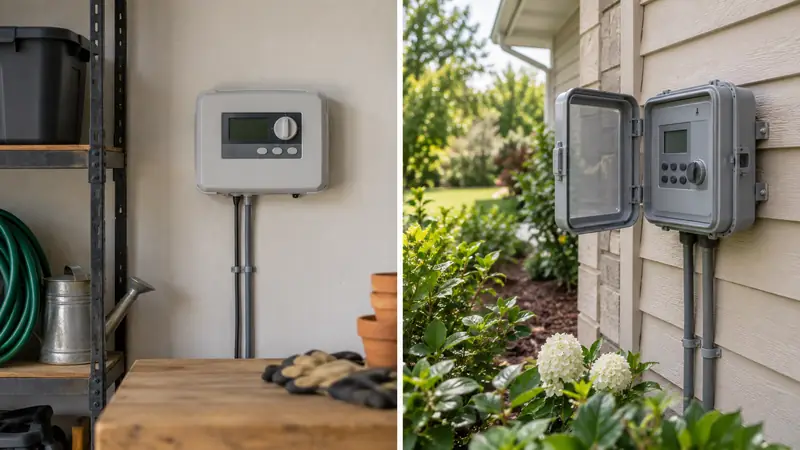
Indoor vs outdoor sprinkler controllers differ mainly in the environment and power arrangement they are built for. The label does not tell you how many zones the unit supports or whether it has WiFi. It tells you where the manufacturer expects it to be mounted and what protection the installation needs. Check the exact model and enclosure before choosing a location.
If the controller needs to go on an exterior wall, our guide to the best outdoor sprinkler controllers compares options by station count, enclosure, power, and controls. Check each model’s installation instructions against the actual mounting spot before choosing one.
Indoor units need a protected spot
An indoor controller belongs in a dry, sheltered area such as a garage or utility room. Many plug into a nearby outlet through an external adapter. That arrangement can be convenient when the valve wires already enter the house, but the controller may not be approved for rain, irrigation spray, condensation, or extreme temperatures.
Do not treat a plastic tote or improvised cover as an outdoor enclosure. A cover can trap heat and moisture, and it may not provide the clearances or wiring protection the product requires. If the only practical location is exposed, choose a model and enclosure specifically rated for that use.
Outdoor models are built around a different installation
An outdoor-rated controller typically has a weather-resistant cabinet and installation details for a protected exterior wall. Power may be supplied by a plug-in transformer or fixed wiring, depending on the model. The cabinet rating does not make every wire connection weatherproof by itself. Use the specified cable entries, conduit, strain relief, and mounting method.
Rain Bird’s controller range includes products identified for indoor or indoor/outdoor use, while Rachio’s documentation describes indoor mounting with an enclosure for outdoor placement. Those are product-specific arrangements, not a general permission to put any indoor timer outside. Check the model’s manual for its approved enclosure, power supply, and environmental limits.
Compare the installation, not the color of the box
| Factor | Indoor controller | Outdoor controller |
|---|---|---|
| Mounting location | Dry interior wall or protected utility space | Exterior location allowed by the manufacturer |
| Weather exposure | Requires a sheltered location | Cabinet and entries are designed for specified outdoor conditions |
| Power | Often uses an external plug-in adapter | May use an adapter or fixed wiring, depending on model |
| Enclosure needs | No extra outdoor cabinet if kept indoors | May include or require a model-specific enclosure |
| Network access | WiFi signal can still be limited by walls or location | Exterior placement may improve or weaken signal depending on the router and construction |
Measure the route from the controller to the system
Where the sprinkler wires enter the building may decide the cleaner installation. Moving the controller outdoors can shorten the low-voltage wire run, but it may require new power wiring or conduit. Keeping it indoors may use an existing outlet, though longer field-wire runs and a weak WiFi signal deserve attention. Check the manufacturer’s permitted wire lengths and output limits rather than estimating from appearance.
For an outdoor installation, consider shade, direct sprinkler spray, standing water, heat, and access for seasonal adjustments. Follow local electrical requirements for receptacles and fixed wiring. If the unit connects directly to household voltage, have a qualified electrician complete work that falls outside your skill or the manufacturer’s instructions.
Indoor and outdoor are separate from smart features
A controller can be WiFi-enabled and still be intended for indoor use. Another may be weather-rated without having app control. Station capacity, valve compatibility, sensor inputs, and network features need their own checks. A weatherproof enclosure does not make a unit compatible with a different valve type or add extra stations.
Which one should you choose?
Choose an indoor model if you have a dry, accessible location near an outlet and prefer to keep the controls protected. Choose an outdoor-rated model when the wiring layout calls for exterior mounting and you can meet its power and enclosure requirements. If you are not certain about the location, compare the model number and installation manual before ordering. The right controller is the one approved for the spot you can actually wire safely.

- Ryan
Ryan Mitchell covers sprinkler controllers, smart irrigation, and watering technology at Best Sprinkler Controllers, with a focus on clear comparisons, practical features, and helping homeowners choose the right setup for their yard.
- Best Irrigation Controllers With Rain Sensor Support November 4, 2026
- Best Sprinkler Controllers for Large Yards: 9 High-Capacity Picks November 2, 2026
- Best WaterSense Irrigation Controllers: 7 Certified Picks October 29, 2026
- Can I Replace an Old Sprinkler Controller With a Smart Controller? October 27, 2026
- Best Weather-Based Irrigation Controllers: 9 Smart Picks October 25, 2026