
Best WaterSense Irrigation Controllers: 7 Certified Picks
The best WaterSense irrigation controllers are easier to evaluate when the exact model number on the box matches an EPA product-directory entry. A product family name can cover several station counts, indoor and outdoor versions, or hardware bundles, and those details are easy to blur in a retailer listing. For this roundup, seven of the nine linked controllers have a corresponding model in the current WaterSense product search. The Rain Bird ESP-TM2 and TRU8O remain as useful conventional comparisons, but the exact names tied to their links could not be confirmed as WaterSense-labeled models. They are alternatives, not certified picks.
That distinction changes how to read this list. A WaterSense label is a useful screening signal, not a promise that any controller will cut a particular bill or qualify for every utility rebate. The system still needs the right station map, sensible runtimes, working valves, and a schedule that reflects the plants and soil. Before purchase, compare the full model number on the retailer package with the EPA WaterSense irrigation controller search, then check the rebate terms published by your own water provider.
Quick Answer
Start with the controller that fits the existing wiring and the way you want to make changes. These four links cover the most distinct certified use cases in the roundup.
- Rain Bird ARC8 is the strongest first look for an eight-station Rain Bird replacement with app and local control.
- Rachio 3 8-Zone is a good fit when remote schedule management matters and the controller can stay in a protected indoor location.
- Orbit B-hyve XR 8-Zone stands out for buyers who want both an on-unit interface and connected weather scheduling.
- Netro Spark suits owners who want plant-oriented schedule tools in a compact, indoor installation.
Comparison at a Glance
Certification status below refers to the model match found in the current EPA search, not every package or regional variation that might share a family name. Check the complete model code before relying on the label or applying for a rebate.
| Controller | EPA listing match | Stations | Control and placement to check |
|---|---|---|---|
| Rain Bird ARC8 | Yes, ARC8 | 8 | App and local controls; confirm the exact enclosure version |
| Rachio 3 8-Zone | Yes, 8-zone configuration | 8 | App-led; protected indoor mounting |
| Rain Bird ARC6 | Yes, ARC6I | 6 | Connected and local operation; check indoor mounting |
| Rain Bird ESP-TM2 8-Station | No exact match confirmed | 8 | Dial and display; optional connected module |
| Rain Bird TRU8IW | Yes, TRU8IW | 8 | Built-in Wi-Fi; protected indoor mounting |
| Rain Bird TRU8O | No exact match confirmed | 8 | Check model suffix, enclosure, and included connection hardware |
| Orbit B-hyve XR 8-Zone | Yes, 57985 | 8 | Indoor or outdoor use; local display and connected control |
| Netro Spark | Yes, Spark-8 | 8 | App and on-unit touch controls; indoor installation |
| Rachio 3 16-Zone | Yes, 16-zone configuration | 16 | App-led; protected indoor mounting |
What WaterSense Certification Does and Does Not Tell You
The label is tied to products that meet EPA criteria and are independently certified. It helps narrow a crowded shelf to models evaluated for efficient irrigation control. It does not confirm that a controller will fit your wiring, survive an exposed location, control a pump, or meet a local utility’s current rebate rules. Those checks remain yours.
Read the exact model code, not the brand name alone. In this roundup, the EPA directory identifies ARC8 and ARC6I as separate products, lists TRU8IW, and includes specific Rachio, Orbit, and Netro configurations. A similar-looking controller with another suffix can have a different enclosure or feature set. If a rebate depends on certification, save a screenshot or PDF of the listing and keep the purchase receipt with the model label.
Why a certified controller can still waste water
Automation can make adjustments more convenient, but it cannot fix a broken sprinkler head, poor pressure, a valve that fails to close, or a lawn divided into mismatched zones. A schedule that runs too long on a slope can send water down a driveway even when the controller has a weather service. A shaded bed and a hot strip of turf rarely need the same frequency. Commission the system first, then judge its schedule by the soil and plants.
Which features matter after installation?
Rain or forecast skips are useful if someone checks that the sensor or weather feed reflects local conditions. App access helps with changes made away from the controller, while buttons and a display make a manual test possible when a phone is not available. Sensor terminals, valve wiring, pump output, and enclosure ratings matter more than extra app screens if the installation depends on them.
How We Compared the Controllers
We treated the EPA match as a verified attribute, then compared each product by station capacity, physical placement, day-to-day control, and the work required to keep its features useful. Station count is a practical limit: six zones can be tidy on a small yard and a dead end on a property with ten independent valves. Wi-Fi is helpful where it reaches the final mounting point, but it adds little if the system is intentionally managed at the wall.
The product sections give more room to traits that change the buying decision. A compact indoor model needs a different explanation from a cabinet intended for outdoor mounting. The two alternatives are described on their own terms and are not counted among the certified seven. No product is presented as field-tested by us, and no rebate eligibility is assumed.
How to Choose a WaterSense Controller for Your System
Count the valves before choosing a station count
Open the existing controller and record each used terminal. Count actual valves, rather than program labels on the display. Leave room for a planned zone only if the wiring and valve manifold will support it. A 16-station model can be sensible for a divided landscape; on a six-valve system with no expansion plans, it may simply take up more wall space.
Match the cabinet to its location
Indoor and outdoor are not interchangeable descriptions. Check the listing for the exact enclosure, the outlet or transformer requirement, and clearance for wiring. A garage controller needs a safe power path and enough room to open its cover. An outdoor cabinet needs a suitable mounting surface and protection as specified by the manufacturer.
Decide where schedule changes should happen
Consider who will run a manual test, pause watering after rain, and adjust seasonal timing. An app-first interface can be convenient for a homeowner who travels or manages several properties. A readable local display can be the better everyday tool for someone who wants to inspect a station without signing into an account.
Verify the extras separately
Do not assume a rain sensor, flow meter, pump relay, weather module, or outdoor enclosure is in the box. Check the controller’s terminals and the accessory’s compatibility before buying. If an incentive is part of the budget, contact the utility with the exact model number before installation; some programs require pre-approval or a dated application.
Setup Checks That Protect the Efficiency Gains
Photograph the old terminals before removing a wire. Label each station, common wire, sensor connection, and pump or master-valve lead. A matching zone count does not guarantee matching terminal positions. After mounting the new unit, run every station for a short test and watch the heads, drip emitters, and valve boxes. Fix poor coverage or leaks before setting an automated schedule.
Build programs around the landscape. Separate turf from beds and drip zones where their water needs differ. On sloped or compacted ground, use shorter cycles with a pause if the controller supports that approach. Confirm that any weather or sensor adjustment changes the schedule as expected, then compare the result with soil moisture rather than relying on an icon alone.
Keep a written record of the controller model, station map, program names, and sensor wiring. That record is useful if a phone is replaced, a family member takes over yard care, or the system needs service next season. Efficiency features earn their keep when the schedule remains understandable after the original setup.
Rain Bird ARC8
For a homeowner replacing an eight-valve controller, the ARC8 balances connected schedule changes with controls at the cabinet. That local access is useful during commissioning: start a zone, confirm the intended valve opens, and stop it without relying on a phone before the wiring is proven.
Rain Bird ARC8 has a corresponding EPA directory record, but the retail family name is not enough for a rebate file. Compare the complete model code on the package with the listed configuration. Rain Bird bundles can vary in enclosure and connection details, so review the installation guide before placing the controller outdoors.
App access helps with seasonal changes and a pause after wet weather, while the on-unit controls provide a direct service point. Neither can correct a leaking valve or uneven sprinkler heads. A short manual test and a baseline schedule still matter more than adding extra start times.
Eight stations cover many established residential layouts, though a new side yard or drip circuit may use the remaining capacity quickly. Sketch the likely valve plan, measure the mounting surface, confirm available power, and test Wi-Fi at the permanent location rather than from inside the house.

Pros
- Eight stations make the model a natural replacement candidate for a common valve count, avoiding a separate expansion decision on day one.
- Local controls provide a practical fallback for a quick station check during installation or seasonal service.
- A verified ARC8 model match gives rebate-minded buyers a concrete certification record to check against the box.
- App access lets an owner pause a wet-weather run from home without making a trip to the controller cabinet.
Cons
- The linked product family can include enclosure variations, so outdoor placement needs a package-level model check before installation.
- A property already using more than eight valves will need a different station plan or controller.
An eight-zone Rain Bird setup with an appropriate mounting location is where ARC8’s local and app controls work together best. Photograph the exact model code before applying for an incentive; a family name alone is not enough to establish the certification match.
To buy this product, click here.
Rachio 3 8-Zone
When schedules need to be changed while the owner is away, the Rachio 3 8-Zone offers a phone-first way to handle weather adjustments and quick runs. It suits a compact valve map better than the 16-zone sibling, so count the station wires before deciding which capacity the yard actually needs.
The EPA directory lists specific eight-zone Rachio 3 configurations, not every generation or bundle carrying the Rachio name. Record the complete model number and compare it with the listing before relying on a rebate. The controller is meant for protected indoor mounting; an exposed location requires the appropriate separate enclosure.
Weather skips are most useful after the baseline has been checked. Soil, slope, shade, and plant type can differ from the data used by a weather service. Start with known runtimes, test each valve, and review automatic changes against the property rather than accepting them as a substitute for irrigation judgment.

Pros
- Weather-based schedule adjustments can reduce the need to visit the controller whenever conditions change.
- Eight stations keep the hardware focused on a typical residential layout rather than adding unused capacity.
- The exact EPA-listed configuration gives a rebate-conscious buyer a specific model record to verify.
- Clear zone names and tested runtimes help an owner confirm that automatic weather changes apply to the intended area.
Cons
- Protected indoor mounting may call for an outdoor enclosure when the existing controller sits in an exposed location.
- The app-centered workflow is less appealing to a household that prefers all programming at the controller.
A phone-based schedule is the reason to choose this Rachio, so network reach and account access need to work at the controller location. If the person responsible for watering wants every adjustment on a physical panel, one of the dial-led Rain Bird models will feel more natural.
To buy this product, click here.
Rain Bird ARC6
Six stations can be the right answer when the valve map is already settled. ARC6 keeps the controller compact for a modest yard where lawn, foundation beds, and a drip area already have separate valves; unused outputs would add cabinet space and setup work without improving coverage.
EPA’s search returns an ARC6I entry. The linked retail name is ARC6, so confirm the final suffix and enclosure on the package before treating it as the certified configuration. That exact match matters if a utility incentive requires the model and receipt to correspond.
Rain Bird’s connected controls help with schedule changes, while local operation gives an installer a direct way to test valve response. The six-station ceiling is the tradeoff: a new side yard or raised beds may require another controller decision if the landscaping is about to expand.
Before removing the old unit, label the common wire and station leads and compare the transformer and sensor connections. Confirm that the exact model is allowed at the intended location. That turns a small-capacity controller into a deliberate match, not a limit discovered after the wiring is loose.
The ARC6’s certification is a useful signal once the model code is confirmed, but it does not settle every installation question. Count current valves and likely additions, then choose the smaller footprint only if the layout will stay within six zones.

Pros
- Six outputs are a clean match for a smaller system, so the buyer does not pay in space and setup complexity for stations that will sit unused.
- Local operation makes a zone-by-zone commissioning check straightforward after rewiring.
- An ARC6I listing appears in the EPA directory, giving buyers a precise model string to compare with the retail package.
- Connected schedule changes let a homeowner adjust a compact valve map remotely while local controls remain available for installation checks.
Cons
- The six-station ceiling leaves little room for a new valve if the yard is likely to expand.
- The linked ARC6 name needs a suffix and enclosure check before assuming it matches the EPA-listed ARC6I.
A six-valve property with no near-term expansion is the natural home for ARC6. If another drip circuit or planting area is already planned, the extra headroom in a larger model is likely worth more than the compact cabinet.
To buy this product, click here.
Rain Bird ESP-TM2 8-Station
The ESP-TM2 is the local-first comparison for a homeowner who would rather use a dial and readable display than manage every setting from a phone. Eight stations cover a familiar residential map, and another household member can pause or run a zone at the cabinet without learning an app.
It is not one of the confirmed WaterSense picks in this roundup. The current EPA search did not return an exact ESP-TM2 match, so do not use the listing for a label-dependent rebate without confirmation from the utility. A carefully built schedule can still support efficient irrigation, but that is separate from certification.
A compatible LNK module adds connected operation, and it may be sold separately. If remote control is a later possibility, compare the module and setup cost with a controller that includes the network hardware. Rain Bird sells indoor and outdoor versions in the family, so check the SKU, enclosure, power access, and existing sensor wires before ordering.

Pros
- The dial and screen keep program changes available at the controller without making a phone or account the primary interface.
- Eight stations cover a common residential wiring map and leave a useful division between turf and planting beds.
- A compatible LNK upgrade lets the buyer defer connected features until there is a clear reason to add them.
- The base timer follows its stored local program without requiring Wi-Fi, leaving the LNK module as an optional later step.
Cons
- The exact ESP-TM2 model was not confirmed in the EPA search, which matters for label-based incentives.
- Remote management depends on buying and configuring a compatible module if it is not included in the selected package.
The ESP-TM2 belongs here as a dial-led alternative, not as a certified choice. Its appeal is the visible local interface; keep it out of a WaterSense rebate application until the utility confirms the exact model.
To buy this product, click here.
Rain Bird TRU8IW
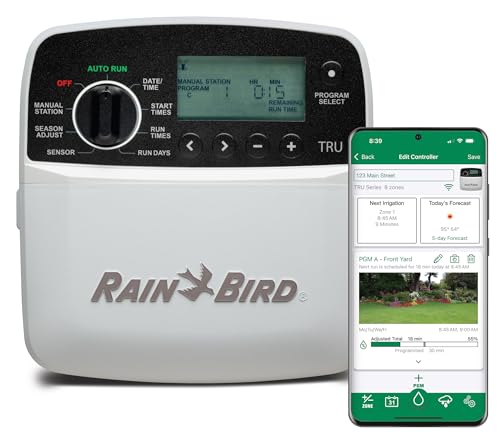
TRU8IW pairs an eight-zone layout with a dial and display at the controller, then adds built-in Wi-Fi for connected access. That arrangement can make commissioning more tangible when several valve wires need to be matched, while leaving ordinary schedule edits available from a phone.
The EPA directory contains an exact TRU8IW record. Check the model code on the retail package, especially if a seller groups indoor and outdoor variants on one page. The listed unit is indoor-only, which points to a garage or utility room rather than an exposed exterior wall.
Connected scheduling is more useful after each station has a clear name and the baseline runtime matches the landscaping. Test the valves at the controller first, then review weather-related changes against the soil and planting areas. A network feature does not correct a poor zone map.
Before removing the old panel, confirm wall space, outlet or transformer access, Wi-Fi strength, and any sensor or pump wiring that must carry over. The indoor placement limit is manageable if the service location is ready; it becomes a deal-breaker if the only practical spot is outside.
Pros
- Built-in Wi-Fi avoids a separate module purchase for the connected functions Rain Bird specifies for this model.
- The dial and display give an installer a direct way to run a station and inspect the program.
- The exact TRU8IW record in the EPA directory is useful for buyers checking a model-specific rebate list.
- Three programs and multiple start times let the eight zones follow separate watering days when turf and planting areas differ.
Cons
- Indoor mounting means an exposed outdoor installation needs a different enclosure solution.
- An eight-station limit can be restrictive on properties with a growing number of independent valve zones.
In a dry indoor service space, TRU8IW combines a hands-on setup with app access and has a model-specific EPA listing to check. The control mix matters less than the mounting restriction if the controller cannot be placed indoors.
To buy this product, click here.
Rain Bird TRU8O
TRU8O is the placement-led comparison for a property where existing valve wires terminate at an exterior location. Eight stations and on-unit programming can make a conventional replacement straightforward, but confirm the precise SKU, enclosure, and network accessories shown in the seller’s package.
The linked TRU8O name did not match an exact EPA listing in the current search, so it is an alternative rather than one of the seven certified choices. If WaterSense labeling is a rebate or purchasing requirement, ask the utility to confirm the full model code before submitting paperwork.
An outdoor-oriented cabinet can avoid extending a long wire run back into the house. It still needs an accessible wall, the specified power arrangement, and protection from direct spray or roof runoff. If an app or weather feature is advertised, check whether its module is included and verify signal at the final position.

Pros
- An outdoor-oriented enclosure can avoid extending a long run of valve wire back into the house when that matches the existing layout.
- Eight stations give an established residential system a straightforward one-to-one place for its active valves.
- Local program access can make a quick manual test possible at the cabinet during maintenance.
- A correctly rated outdoor cabinet may avoid the separate protective enclosure needed by indoor-only controller models.
Cons
- The exact TRU8O model did not appear in the EPA search, so it should not be counted as a confirmed WaterSense pick.
- Retail packages may differ on network hardware; check the precise SKU and contents before budgeting for remote control.
When an exterior wire run makes relocation impractical, TRU8O may be worth comparing as a conventional controller. Its model and enclosure need to match the site, and a rebate-focused buyer should choose from the seven EPA-matched options instead.
To buy this product, click here.
Orbit B-hyve XR 8-Zone
Orbit B-hyve XR 8-Zone stands out for a buyer who still wants a useful display and buttons at the controller. The app adds weather scheduling and remote changes, while the panel remains a visible place to check stations during maintenance. Orbit identifies model 57985 as the eight-zone XR, and that identifier appears in the EPA search.
Indoor or outdoor placement is supported for this model, with dual-band Wi-Fi and Bluetooth for setup and connected operation. Outdoor capability does not make every wall suitable: check power, signal, access, and the installation guide for the exact mounting conditions.
Four program slots and cycle-and-soak can help separate slow-absorbing areas from ordinary turf zones. Those options work best when each station maps to the right valve. Name the programs clearly and keep a short note of start times so overlapping schedules do not water the same area twice.
Eight stations are a fixed ceiling. If the property is adding valves or a drip manifold, compare a larger controller before moving wires. For an established eight-valve system, the local display has a specific service benefit: someone can inspect the setup at the wall without reconstructing it from a phone.
Certification depends on the exact model code, not the B-hyve family name. Match 57985 to the package and keep that record with any utility paperwork.

Pros
- The local color display makes on-site station checks accessible even when the app is not the preferred tool.
- Orbit’s 57985 model is listed by EPA, which gives certification-focused buyers an exact identifier to compare.
- Cycle-and-soak and four program slots can help separate slow-absorbing areas from ordinary turf zones.
- Dual-band Wi-Fi and Bluetooth give the installer flexible setup options before using the XR’s app-based weather schedules.
Cons
- The eight-zone XR has limited headroom for a property adding valves or separate drip areas.
- Outdoor rating does not remove the need to follow the specified power, mounting, and exposure instructions.
Model 57985 is the XR version to match against the EPA entry. It makes sense when a connected schedule and a local display are both useful and eight outputs fit; a growing valve map needs a higher-capacity choice.
To buy this product, click here.
Netro Spark
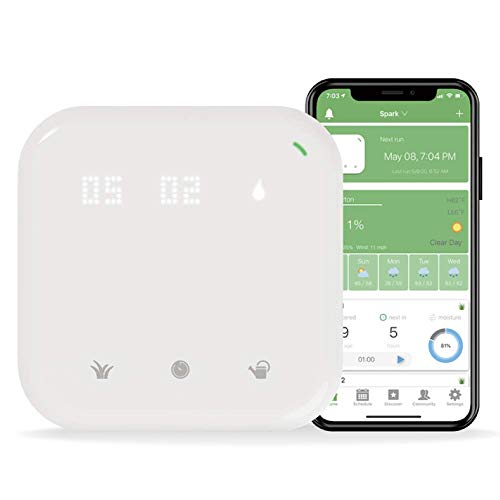
Spark-8 is the Netro configuration to compare here. Its directory entry and model suffix matter because the product family also includes a sixteen-zone version. The eight-zone Spark combines on-device touch controls with app scheduling and uses 2.4 GHz Wi-Fi.
Netro describes an indoor installation, a backup program, and plant-focused schedules. That combination is more at home in a garage or protected utility room than on an exposed wall. Test the network at the controller and decide whether the person maintaining the yard is comfortable doing the detailed schedule work in the app.
Automated adjustments do not remove the need to name each zone accurately or inspect the emitters. A clogged filter or poorly aimed head will not be corrected by a schedule with more inputs. Netro has described valve diagnostics as a beta feature, so treat it as an extra rather than a guaranteed buying benefit.
Pros
- The Spark-8 appears in the EPA directory, providing a specific model match for certification checks.
- On-device touch controls make basic interaction less dependent on opening the app for every task.
- A backup program offers a fallback schedule if the owner needs to recover the setup.
- Plant-focused schedules can give lawn, beds, and shrubs more relevant starting points than a single generic calendar.
Cons
- The indoor-only installation rules out an exposed controller location unless a compliant protected cabinet is provided.
- The eight-station version leaves less room than the Spark-16 for a growing valve map.
Spark’s case rests on its indoor installation, touch controls, and app-based scheduling, not on a broad product-family label. Verify Spark-8 on the package and use its diagnostic features only as supplemental information.
To buy this product, click here.
Rachio 3 16-Zone
Sixteen stations make the larger Rachio useful when an eight-zone panel would force separate valves together or leave little room for planned additions. A divided property with lawn, side strips, trees, beds, and drip areas can keep those circuits on schedules that reflect their different needs. On a smaller yard, unused outputs add little.
EPA lists specific 16-zone Rachio 3 configurations. Match the retail package to the exact variant rather than assuming every related model is covered. Like the eight-zone sibling, this is an app-centered controller intended for protected indoor mounting; include the necessary enclosure if the old panel is exposed.
Weather skips can reduce unnecessary cycles, while clear zone names help an owner review programs across a larger property. Start with known runtimes, test each valve, and check automatic changes against actual soil and plant conditions before relying on them without attention.
More stations do not create more water pressure, wire length, transformer capacity, or flow. Verify those limits before adding a valve. If sixteen circuits already exist, preserve a photograph of the original common and station wiring before disconnecting the old controller.

Pros
- Sixteen independent outputs help keep a large, mixed landscape from sharing a single runtime where needs differ.
- App-based weather tools make it easier to review a schedule across a property with many zones.
- An exact 16-zone EPA listing gives rebate-conscious buyers a model-specific point to verify.
- Clear names and individual runtimes make a large station map easier to review after a schedule change.
Cons
- Protected indoor mounting may require a separate outdoor enclosure if the old controller is exposed.
- The larger station count adds little on a compact system and does not replace checks for pressure, wiring, or flow.
For an indoor installation with a valve map already near sixteen zones, this Rachio offers useful headroom and a specific EPA model record to verify. A stable six-to-eight-valve yard is better served by the smaller version.
To buy this product, click here.
Frequently Asked Questions
Does a WaterSense label guarantee a utility rebate?
No. The label identifies a model that meets the EPA specification, while each utility sets its own rebate rules, dates, paperwork, and installation requirements. Check with the provider before buying, and give them the full model number from the package rather than a family name. Keep the receipt and the model label if the program asks for proof.
Are every version and station count in a product family certified?
No. The EPA search lists exact model configurations. A suffix can identify a different station count, enclosure, or bundle. This roundup found seven corresponding model records and could not confirm the ESP-TM2 or TRU8O under the names used for those links. Confirm the retail SKU against the directory if certification is a requirement.
Can a WaterSense controller work without Wi-Fi?
Some models retain local buttons, dials, or a display, while their connected features depend on a network or separate module. The practical question is whether you can commission the valves and manage the program if the internet is unavailable. Read the model manual for offline operation before choosing a controller whose main workflow is app-based.
How many stations should I buy?
Count the active valve wires at the existing controller and add only the capacity that has a real expansion plan behind it. Extra stations do not create more water pressure or solve a hydraulic limit. If a new zone is planned, check the manifold, wire run, transformer, and available flow as well as the controller output count.
Do forecast skips replace a rain sensor?
Not necessarily. A forecast feed estimates conditions over a region; a local sensor responds to conditions at the property. Their compatibility and behavior depend on the controller model and wiring. Avoid connecting an accessory until the manual confirms the terminals and the expected response, then test the schedule to see whether a run is actually paused.
Can I use a smart controller for drip irrigation?
Yes, if the valves, pressure, filtration, and emitter layout are appropriate and the drip areas are programmed separately from turf where their needs differ. A controller changes timing; it does not regulate every hydraulic problem. Inspect the filter, flush the line, and check for clogged or mismatched emitters before adjusting runtimes.
What should I verify before removing the old controller?
Photograph the terminals, label each station and common wire, and identify any sensor, pump, or master-valve connection. Confirm power requirements, enclosure location, and the new unit’s terminal compatibility. A wire map makes the replacement easier to troubleshoot and gives the next person a useful record after the schedule has been set.
Final Take
For a certification-led purchase, start with the exact EPA model record, then make the station map and mounting location the deciding checks. Seven products here have a corresponding current listing; ESP-TM2 and TRU8O remain alternatives rather than certified selections. Among the linked options, ARC8 and Rachio 3 cover two distinct connected workflows, while the Orbit XR is the stronger fit when local display access matters.
Before ordering, compare the full model number, verify the enclosure and connection hardware, and confirm any rebate directly with the utility. After installation, test each valve and keep the first schedule easy to review. A clear baseline, properly divided zones, and routine inspection do more to make efficient watering dependable than a feature list by itself.

- Ryan
Ryan Mitchell covers sprinkler controllers, smart irrigation, and watering technology at Best Sprinkler Controllers, with a focus on clear comparisons, practical features, and helping homeowners choose the right setup for their yard.
- Best Irrigation Controllers With Rain Sensor Support November 4, 2026
- Best Sprinkler Controllers for Large Yards: 9 High-Capacity Picks November 2, 2026
- Best WaterSense Irrigation Controllers: 7 Certified Picks October 29, 2026
- Can I Replace an Old Sprinkler Controller With a Smart Controller? October 27, 2026
- Best Weather-Based Irrigation Controllers: 9 Smart Picks October 25, 2026